
Hand-tufting is genuinely done by hand, which is exactly what makes the term so effective commercially and so misleading.
How it is made
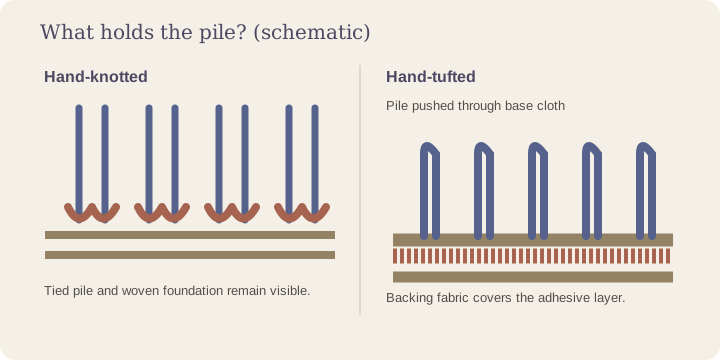
A pattern is drawn onto a stretched cloth backing. The maker stands at the front and punches yarn through it with a hand-held tufting gun, working across the design. The loops are held in place only by friction until the back is coated in latex adhesive, and a secondary backing cloth — the scrim — is glued over the top to hide the mess.
Tufting avoids tying each pile knot individually and can be faster to produce than a comparable hand-knotted rug. The production time still depends on size, design, team and finishing.
Identifying one
Look at the back
A plain fabric backing glued over the structure means tufted. You cannot see the design on the reverse, and you cannot see individual knots. Peel back a corner of the fringe if there is one — on a tufted rug the fringe is a separate strip sewn on.
There is also a smell. New tufted rugs frequently off-gas from the latex, a distinct rubbery odour that fades over weeks. A genuine wool rug smells faintly of wool.
What can limit its life
The adhesive and backing are additional failure points to inspect, alongside pile wear. Their service life varies by materials, manufacture, storage and use.
| Hand-tufted | Hand-knotted | |
|---|---|---|
| Pile anchoring | Adhesive-backed cloth | Knots in a woven foundation |
| Common repair concern | Backing or adhesive failure | Worn foundation or pile |
| Repair options | Local repairs may be possible; widespread backing failure is difficult | Local reweaving is often possible |
| Price comparison | Compare actual size, wool content and backing | Compare actual size, wool content and knotting |
Adhesive can harden and lose grip over time, and widespread failure may be uneconomic to repair. There is no dependable age at which every tufted rug fails. The comparison in full is in wool rug durability.
Where tufting is the right answer
It genuinely is, sometimes. A rug for a room you will reconfigure in five years. A nursery that will be redecorated. A rental. A large area where the alternative is bare floor and the budget will not stretch to knotting.
In those cases, a well-made tufted rug may meet the need without paying for a more labour-intensive construction.
In its favour
- Often less expensive than a comparable hand-knotted rug
- Thick, soft, plush underfoot — often more immediately comfortable
- Design freedom: any drawing can be tufted, including large abstract fields
- Available quickly and in consistent, repeatable colours
Against it
- Adhesive and backing add failure points
- Widespread backing damage can be difficult to repair economically
- Shedding can worsen if the backing loosens
- Cleaning method must account for the adhesive
- Resale value is often limited
Care
Do not assume a tufted rug can be immersed or treated like a woven rug. Ask a cleaner to identify the backing and test an appropriate method first — see cleaning methods.
Otherwise: use a pad, vacuum with suction rather than a beater bar, and accept the shedding in the first year.
Buying honestly
Ask directly whether the rug is hand-knotted or hand-tufted, and get the answer on the invoice. Priced honestly as a tufted rug it is fair value. Priced as though it were knotted it is a poor purchase. Start with the back, then use the hand-knotted identification checklist to confirm the structure.
See rug prices for what each construction should cost.
How long you actually get
How long hand-tufted rugs last explains how backing, adhesive, traffic and storage affect service life.
Persistent or increasing shedding is a reason to inspect the backing; it is not enough on its own to diagnose adhesive failure. The new-rug shedding guide explains which other signs to document.
Everything on hand-tufted rugs
The 1 areas this subject divides into, and the guides beneath each.
- How Long Hand-Tufted Rugs Last — The ceiling is chemistry, not wear — latex degrades on its own schedule, so a tufted rug in a spare room and one in a hallway fail at roughly the same age.
Every guide in Hand-Tufted
All 1 article in this section, starting with the ones we would hand someone new to it.
- How Long Hand-Tufted Rugs Last — start here
Common questions
Are hand-tufted rugs bad?
Not bad — limited, and frequently mispriced. Tufting produces an attractive rug quickly and cheaply, which is a legitimate product. The problem is that "hand-made" language lets buyers conclude hand-knotted and pay accordingly for something with a an unverified promise of the same life and repair options.
Why does my hand-tufted rug shed so much?
The pile is held in by latex adhesive rather than by knots. As the latex hardens and breaks down, tufts can work loose and shedding can become persistent. Construction, adhesive, use and storage affect when this happens; shedding alone is not a diagnosis.
Can a hand-tufted rug be repaired?
Small local repairs may be possible. Widespread adhesive or backing failure is much harder to repair economically; ask a rug repairer to assess the actual piece.