
Hand-knotting is the construction against which every other rug is defined, and the attribute most often implied without being stated.
What actually happens
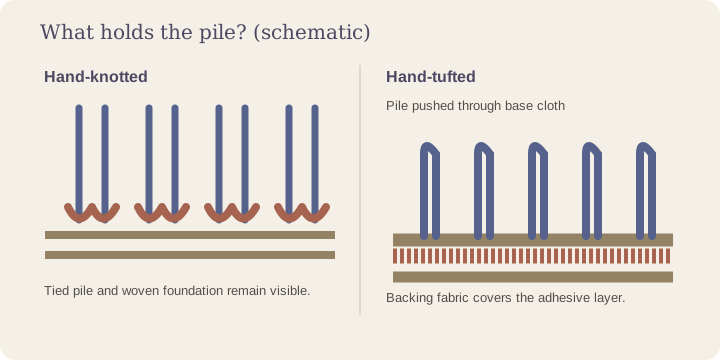
A weaver ties individual knots of pile yarn around pairs of warp threads stretched on a loom, working row by row. Each row is secured by one or more weft passes and beaten down with a comb. The pile is held by the knots themselves — nothing is glued, nothing is stitched on, and the structure visible on the back is the rug.
For the full sequence from warping the loom to finishing the edges, see how a hand-knotted rug is made.
Two knots dominate. The asymmetrical knot wraps one warp fully and passes behind the other, allowing finer curvilinear drawing; it is standard in Persian city weaving. The symmetrical knot wraps both warps evenly and is more robust; it is standard in Turkish and much Caucasian work. Tibetan weaving uses a third method entirely — a cut loop over a gauge rod.
The check
Turn the rug over
Hand-knotted: the design reads clearly on the back, knots look slightly irregular, and the fringe is the warp itself. Hand-tufted: a fabric scrim glued over the back hides everything. Machine-made: a mechanically perfect grid, often with a stiff backing, and a fringe sewn on afterwards.
That is a useful first check, not proof on its own. If origin or value matters, ask for clear photographs of both faces and an independent assessment.
The step-by-step identification guide shows what to look for on the reverse, in the pile and at the ends.
The arithmetic
Knot counts can help describe construction, but they do not set a rug's price by themselves.
| Rug | Density | Approx. knots |
|---|---|---|
| 3×5 ft | 150 KPSI | 324,000 |
| 6×9 ft | 150 KPSI | 1,166,000 |
| 8×10 ft | 200 KPSI | 2,304,000 |
| 9×12 ft | 200 KPSI | 3,110,000 |
| 9×12 ft | 400 KPSI | 6,220,000 |
The knot totals above are area multiplied by density, rounded to whole thousands. This does not establish weaving time: the number of weavers, pattern and finishing work change the schedule. A low price is a reason to check the construction and seller's description, not proof of a mislabelled rug.
What it buys
In its favour
- Repairable — reweaving, repiling and reselvedging return it to service
- A sound woven foundation can be maintained and repaired over time
- Some examples retain resale value; condition and attribution decide how much
- Worn areas can sometimes be rewoven instead of replacing the whole rug
Against it
- Substantially more expensive at every size
- May need specialist cleaning when routine care is insufficient
- Quality varies enormously within the category — the label guarantees little
- Not worth paying for if the rug will be destroyed within a few years
That last point deserves emphasis. Hand-knotted is a construction, not a grade. A coarse, badly dyed hand-knotted rug is a worse object than a good machine-made one and costs more. What the construction gets you is entry to the category where the quality questions start to apply.
Density in context
Knot density can be expressed in different units, so ask for the unit and measurement method before comparing two quoted counts. More knots in an area may allow finer detail, but density alone does not grade a rug. The design, foundation, fibre, condition and weaving tradition all matter. Read what a rug's knot count can and cannot tell you for a practical counting method and the limits of the number.
Alternatives
If longevity is not the point, the honest alternatives are machine-made rugs for cost, flatweaves for low profile, and hand-tufted rugs for appearance at a price — with a clear understanding of what the latter's lifespan actually is.
If you own a woven rug already, hand-knotted rug care explains which routine tasks are safe at home and when the condition needs a specialist.
Everything on hand-knotted rugs
The 6 areas this subject divides into, and the guides beneath each.
- How Hand-Knotted Rugs Are Made — From fleece to finished rug — shearing, spinning, dyeing, warping, knotting, shearing and washing, and how long each stage actually takes.
- Judging Quality in Hand-Knotted Rugs — The signals that separate a good hand-knotted rug from a poor one — and why knot count is the least useful of them on its own.
- How Long Hand-Knotted Rugs Last — Realistic service life by traffic and care, what fails first, and the maintenance decisions that move a rug between thirty years and a hundred.
- What Hand-Knotted Rugs Cost — Price ranges by grade and size, what you are actually paying for at each tier, and the labour arithmetic that makes the numbers legible.
- Hand-Knotted vs Other Constructions — Honest trade-offs against tufted, machine-made and flatweave — including the cases where hand-knotting is the wrong thing to buy.
- Caring for Hand-Knotted Rugs — Maintenance specific to knotted construction — why the foundation is what you are protecting, and the routine that makes a hundred-year life realistic.
Every guide in Hand-Knotted
All 8 articles in this section, starting with the ones we would hand someone new to it.
- Hand-Knotted vs Other Constructions — start here
- Judging Quality in Hand-Knotted Rugs — start here
- What a Rug's Knot Count Can (and Cannot) Tell You — start here
- Caring for Hand-Knotted Rugs
- How Hand-Knotted Rugs Are Made
- How Long Hand-Knotted Rugs Last
- How to Tell if a Rug Is Hand-Knotted
- What Hand-Knotted Rugs Cost
Common questions
How do I know if a rug is hand-knotted?
Turn it over and look for individual pile knots in a woven foundation. A visible reverse pattern is useful, but machine-woven rugs can show one too. Integral fringe is another clue, though repaired or finished ends make it inconclusive on its own.
Does a higher knot count mean a better rug?
Not by itself. Density can show how finely a design is knotted and may reflect additional labour, but it does not measure wool, dye, condition or design. Compare similar constructions, and use the count alongside other evidence.