
The word tile hides an important distinction. Glazed ceramic or porcelain, natural stone, and vinyl or luxury vinyl tile do not all react to rug backings the same way. Identify the floor first. Then decide whether the room needs grip, easy laundering, cushioning or an unobstructed heated floor.
Identify the floor beneath the rug
| Floor | First question | Why it matters |
|---|---|---|
| Glazed ceramic or porcelain | Is it wet or slippery in this room? | Grip and drying usually drive the choice |
| Natural stone, polished or sealed | What does the stone and sealer maker allow? | Finish and sealer care vary |
| Vinyl or luxury vinyl tile | Does the maker restrict rubber or latex? | Some resilient floors can discolor under certain backings |
| Any heated tile | What does the heating-system manual allow? | A rug and pad can change heat transfer and local floor temperature |
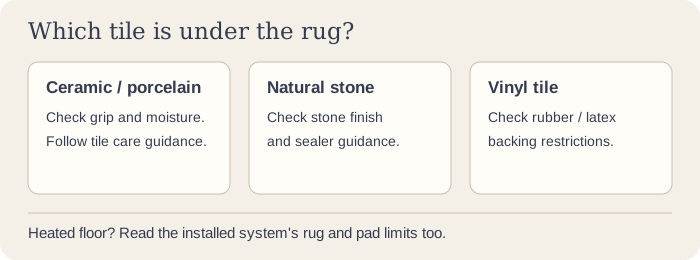
This distinction corrects a common error: Armstrong's warning about rubber and latex backings is for its vinyl floors. It does not establish that a rubber pad will stain ceramic tile or cement grout in the same way. Natural stone adds another variable: its finish and sealer need their own care guidance. MSI's marble guidance calls for a slip-resistant rug underside and keeping the floor dry.
Grip without a floor problem
The rug must stay flat when someone walks, turns or pulls a chair across it. Do not assume a heavy rug grips a polished floor, or that a product labeled “nonslip” is compatible with every finish. Test a candidate pad in an inconspicuous place and follow the floor maker's instructions. The pad-by-floor guide explains why vinyl, stone and ceramic need separate checks.
For a bathroom, the CDC recommends mats with nonslip backs. That is a safety goal, not a universal endorsement of any particular backing chemistry. If a pad slides, curls, leaves residue or changes the finish, replace it with a compatible product. Avoid an edge that catches a door or chair. Cut a separate pad slightly inside the rug's edge according to its maker's fitting instructions.
Keep the interface dry
Tile may be chosen for wet rooms, but a textile left damp against it can still smell, soil the floor beneath or dry slowly. Pick a rug that can be lifted and cleaned in a kitchen or bathroom. Check both faces and the floor after a spill or wash, and let them dry before putting the rug back. A nonpermeable backing can make inspection and drying harder.
If a bath mat develops a persistent odor, use the bathroom moisture checklist to inspect the rug, backing and floor together.
In a dry living room, wool, cotton, flatweave and suitable synthetics can all work. Construction and the room's use matter more than the tile itself. Jute or viscose requires more care where water is likely.
Check heated floors with the system maker
Do not borrow a single thermal limit from an unrelated carpet installation. Electric and water-based systems, sensor positions and floor assemblies differ. For example, Warmup's area-rug guidance allows a thin rug without rubber backing for the system it discusses, while warning against thick coverings, especially around the floor sensor. Nu-Heat discourages rugs on its underfloor heating because they reduce heat output; if one is used, it advises keeping thermal resistance low.
Check the exact heating manual
Read the requirements for your installed system and its floor sensor. Ask the rug and pad makers for thermal-resistance information if the manual gives a limit. If those values are unavailable, do not guess that a thick or rubber-backed assembly is safe because the tile itself tolerates heat.
A universal 2.5-tog allowance and construction-by-construction tog figures are not dependable for an unknown heated tile system. We also found no test demonstrating that rubber backings routinely stain cement grout. Do not use those assumptions to choose a product.
Match the room, then confirm the product
- Kitchen: Choose a low-profile rug that can be cleaned and dried after frequent spills; check door and appliance clearance.
- Bathroom: Prioritize secure grip, prompt drying and a care label you can follow.
- Entryway: Choose a surface that captures tracked-in grit and can be lifted to clean the tile beneath — see entryway rugs.
- Living room: Choose the size and feel you want, then test grip on the actual tile. The size guide helps establish the footprint.
The useful buying question is not “which rug works on tile?” but which floor is this, what happens in this room, and what does the floor or heater maker permit? Those answers narrow the rug and pad choices without relying on a blanket material rule.
Common questions
What rug is best on a tile floor?
First identify whether the floor is ceramic or porcelain, natural stone, or a resilient product marketed as vinyl tile. Then choose a rug suitable for the room's moisture and traffic, and a pad the floor maker permits. Grip and drying matter more than a universal fiber recommendation.
Will a rubber-backed rug damage tile?
Do not treat every tile floor as the same material. Some vinyl-floor makers warn that rubber or latex backings can discolor their products. That warning does not prove the same reaction on glazed ceramic or cement grout. Check your flooring maker's instructions and test any pad on a discreet area.
Can I put a rug over heated tile?
It depends on the heating system. Some manufacturers permit thin rugs but warn against thick or rubber-backed coverings, especially near a floor sensor. Others discourage rugs because they reduce heat output. Follow the exact system manual and check the combined rug-and-pad thermal resistance where required.
Does a heavy rug need a pad on tile?
Weight alone does not prove a rug will stay put. Test it when walking and turning; if it slides, use a floor-compatible nonslip pad. Keep the rug and floor dry, especially in kitchens, bathrooms and entryways.