
Wool has been the default rug fibre for three thousand years, and the reasons are structural rather than traditional. It is worth understanding them, because they also explain the handful of places wool is the wrong answer.
What makes wool work
- Resilience
- Fibre is naturally crimped — it springs back after compression
- Soil resistance
- Lanolin and a scaled surface shed dry soil
- Moisture
- Absorbs ~30% of its weight without feeling damp
- Flame
- Naturally flame-retardant; self-extinguishes
- Dye
- Protein fibre — takes natural dye deeply and permanently
- Repairability
- Can be rewoven, repiled and reselvedged
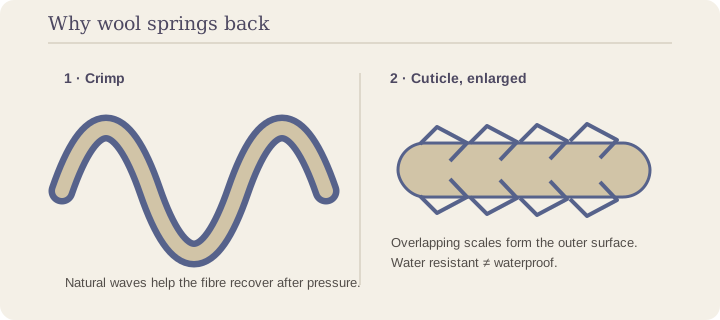
The crimp is the key property. Each wool fibre has a natural three-dimensional wave, and compressing it stores energy that releases when the load comes off. That is why furniture indentations in a wool rug recover and why the traffic lines take years rather than months to appear.
The second property is the scaled surface. Wool fibres have overlapping cuticle scales that help resist some surface wetting. That does not make a rug stain-proof: the rug's construction, dye and any added finish all affect how it responds to a spill.
Wool is also naturally resistant to ignition and tends to char when exposed to flame. That is a fibre property, not a fire-safety certification for any particular rug.
Where wool is the wrong choice
Three situations, and being straightforward about them is more useful than pretending wool wins everywhere.
Genuinely wet areas. Bathrooms, poolside, anywhere with standing moisture. Wool handles humidity well and sustained wetting badly — the foundation is the vulnerable part, not the pile.
Direct, sustained sunlight. Wool fades. So does everything, but solution-dyed synthetics fade dramatically less, which is why they dominate outdoor and conservatory use.
Short-horizon rooms. A rental, a nursery that will be reconfigured in three years, a student flat. Wool's advantage is longevity, and paying for longevity you will not use is simply paying more.
Cost, and what it buys
Wool commonly costs more than a comparable synthetic, but the difference changes with construction, size and seller. Compare specific rugs at the same size and construction, then consider care and repair costs alongside the ticket price.
| Wool, hand-knotted | Wool, machine-made | Polypropylene | |
|---|---|---|---|
| How pile is held | Knots in a woven foundation | Mechanically woven | Mechanically woven |
| Local pile repair | Often possible; assess the rug | Depends on construction | Usually uneconomic |
| What decides useful life | Foundation, wear and care | Wear, backing and care | Wear, backing and care |
The durability factors are set out in full, and the honest account of the trade-offs is in pros and cons.
Not all wool is equal
The word covers a wide range. Highland and mountain wool — from sheep grazing poor pasture at altitude — has higher lanolin content and longer staple, and it is noticeably springier and more lustrous than lowland wool. New Zealand wool is prized for whiteness and takes light colours cleanly.
What to avoid is dead wool (also called skin wool), pulled from hides after slaughter rather than shorn. It is brittle, dull, sheds persistently and wears out fast. It feels dry and slightly crunchy rather than springy, and it is common in cheap machine-made rugs sold simply as "100% wool", which is a true statement that conceals the relevant one.
The full fibre assessment is in wool rug properties.
Living with wool
Vacuum weekly with suction, vacuum the reverse twice a year, rotate every six months, use a pad, and arrange a professional wash when condition and use call for it. See cleaning wool rugs and the general rug cleaning guide.
If a new rug is releasing fiber, compare normal shedding with signs of pile loss before deciding whether to contact the seller.
For where a wool rug earns its keep most obviously, see wool rugs for the living room.
For a purchase decision, compare wool with synthetics on price, care and room conditions in wool vs synthetic rugs.
Everything on wool rugs
The 6 areas this subject divides into, and the guides beneath each.
- Wool Rugs: Fibre Properties — The physical structure behind wool's behaviour underfoot — crimp, cuticle scales, lanolin and moisture regulation — and how to judge wool quality by hand.
- How Durable Are Wool Rugs? — Realistic service life for wool by construction and traffic level, what wears first, and the maintenance decisions that move a rug between the ranges.
- Cleaning Wool Rugs — Safe cleaning for wool specifically — why pH matters, what felting is and how to avoid it, and the products that quietly damage the fibre over time.
- What Wool Rugs Cost — Price expectations for wool by construction and grade, what drives the range, and the cost-per-year arithmetic that makes wool cheaper than it looks.
- Wool Rugs: Pros & Cons — A straight assessment of where wool rugs succeed and where they genuinely disappoint, including the shedding, the smell and the cost that nobody mentions.
- Wool Rugs vs Other Fibres — How wool compares against nylon, polyester, polypropylene, silk, cotton and the plant fibres — where each genuinely wins, without pretending wool wins everywhere.
Browse by
Guides written to a single dimension — colour, size, weave, age.
Every guide in Wool
All 8 articles in this section, starting with the ones we would hand someone new to it.
Common questions
Are wool rugs worth the extra cost?
Wool's resilience and repairability can justify a higher price in a room where you expect to keep a rug for years. Construction, traffic and care matter too, so no single lifespan multiplier is reliable across all wool and synthetic rugs.
Do wool rugs shed?
Some loose fiber is normal in a new wool rug and should generally decline with suitable vacuuming. The amount and timing vary by construction. Persistent shedding plus visible thinning or detached tufts needs inspection; shedding alone does not prove a backing defect.
Are wool rugs good for allergies?
Fibre alone cannot tell you whether a rug will be comfortable for someone with allergies. Dust and other allergens can collect in any rug. Follow medical advice for your household and maintain the rug according to its care instructions.