
Anatolian weaving includes many regional and workshop traditions. A “Turkish rug” label can refer to a place, a design tradition or a style description, and those meanings do not always line up. Origin is best assessed from several features together.
The knot
Many Anatolian pile rugs use the symmetrical knot, also called the Turkish or Gördes knot. Other knot structures appear across Turkey and elsewhere. Knot type is useful construction evidence, but it cannot establish a rug's geographic origin by itself or explain a whole design tradition. Read what makes a rug Turkish for the terminology and a fuller account of its limits. The construction checks in rug identification are useful here too.
The regional styles
- Oushak
- Large scale, open field, apricot and gold, lustrous wool
- Hereke
- Court production, very fine, often silk — the exception to the rule
- Bergama
- Bold geometric medallions, deep madder red
- Konya
- Among the oldest surviving Anatolian weaving; archaic drawing
- Kayseri
- Commercial production, frequently mercerised cotton sold as silk
- Yörük
- Nomadic, coarse, wool foundation, saturated natural dye
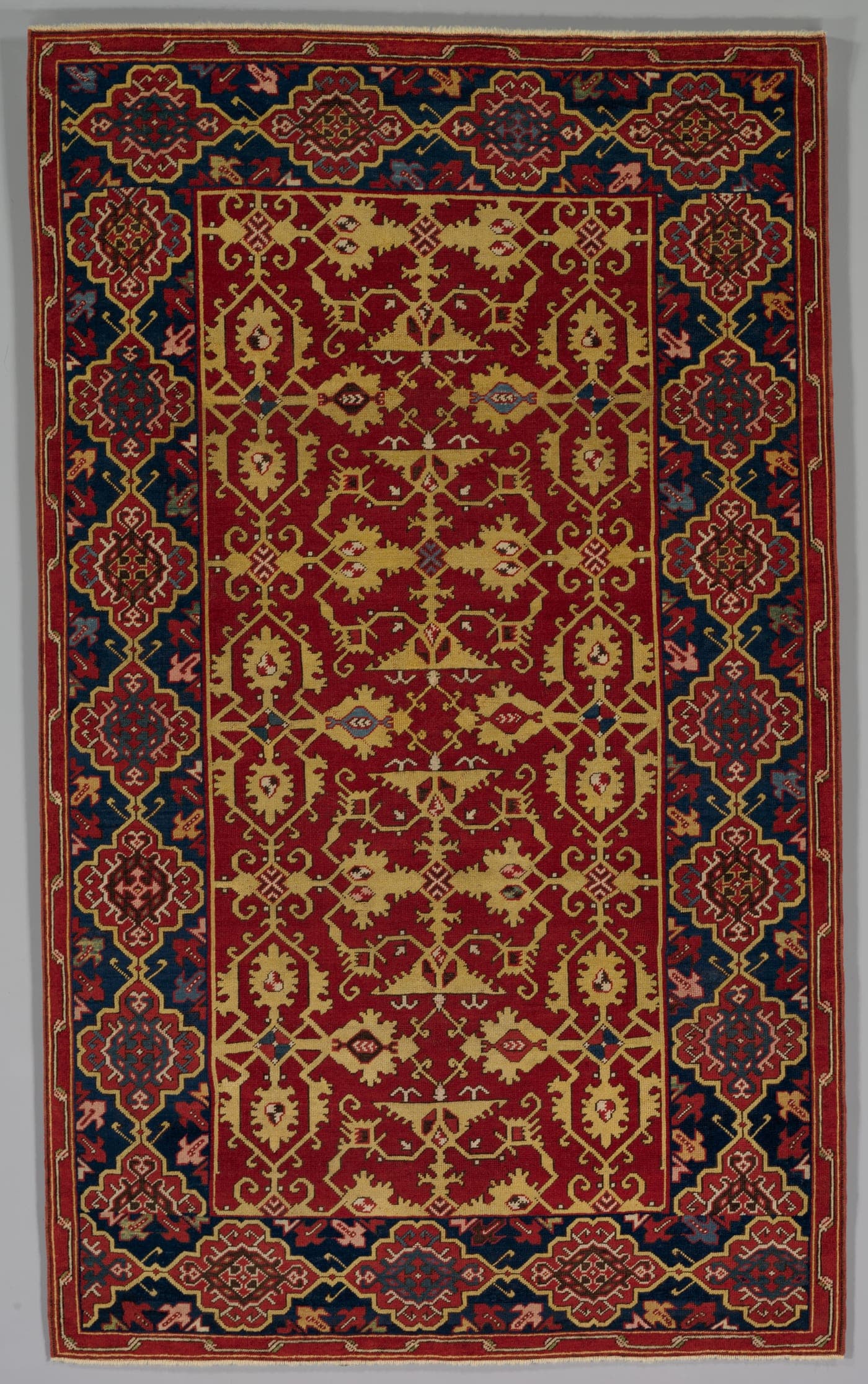
The Lotto pattern, named after the painter who put it in his portraits — European painting is part of how these carpets are dated, because a rug in a picture with a known date puts a floor under the design. Note the symmetric knot in the museum's record, and what it does to the drawing: the arabesques resolve as angles rather than curves.
wool: symmetrical rug knot
Cleveland Museum of Art, 2015.61 · Purchase from the J. H. Wade Fund · CC0
Oushak dominates the decorative market. Antique examples in room sizes are expensive and widely reproduced, and the reproductions are often good. The give-away on age is dye behaviour and wear pattern rather than design.
Hereke is the anomaly: an imperial workshop founded in 1843 producing extremely fine silk and wool carpets to court standards. Hereke signatures are forged more often than almost any other, so treat one as a claim to verify.
Kayseri deserves specific caution. Mercerised cotton — sometimes called "Turkish silk" — is produced there in quantity and sold to tourists as silk. The burn test settles it: real silk self-extinguishes and smells of burnt hair; mercerised cotton burns fast with a paper smell. More in silk rugs.
The prayer rug
The single most recognisable Anatolian format is the prayer rug: a directional design with a mihrab, an arched niche pointing towards Mecca. Turkish prayer rugs are woven across almost every region, and the format carries real cultural weight rather than being decorative.
Two practical notes. Directional designs look wrong laid out in a room without thought about which way the niche points. And genuine antique prayer rugs in good condition are comparatively scarce, because they were used.
Colour
The Anatolian palette runs warmer than the Persian: apricot, saffron, terracotta, madder red, and a distinctive soft green from indigo over yellow. Where Persian city weaving tends towards deep madder and indigo formality, Turkish weaving is more likely to be bright, open and high-contrast.
Turkey also has the strongest natural-dye revival in the weaving world. The DOBAG project, begun in the early 1980s, re-established vegetable dyeing and hand-spinning in Anatolian village production, and DOBAG rugs are genuinely what they claim to be — a rarity worth knowing about. How dyes age is covered in rug colors.
Buying
Compare a rug by its region, materials, condition, design and evidence for its age. Knot type and density can add useful construction detail, but neither one establishes origin or overall quality. The Turkish knot guide explains why the name is not a geographic certificate.
Kilims are a separate and very large part of Turkish production — flatwoven, reversible and a different craft entirely. See kilim rugs.
The inspection sequence is the same as anywhere: construction, fibre, region, age, condition, then price. It is set out in how to buy Persian rugs, and in rug value and appraisal.
Every guide in Turkish
All 1 article in this section, starting with the ones we would hand someone new to it.
- What Makes a Rug Turkish? — start here
Common questions
Does a Turkish knot prove that a rug was made in Turkey?
No. The symmetrical knot is associated with Turkish weaving but is also used elsewhere, and Turkish rugs can use other knot structures. Use knot type as one construction clue among several, not as proof of origin. See our guide to [what makes a rug Turkish](/turkish-rugs/what-makes-them).
What is an Oushak rug?
Weaving from the Uşak region of western Anatolia, known for large-scale open designs, soft apricot and gold tones, and a lustrous long-staple wool. Antique Oushaks are among the most sought-after decorative carpets in the market, and the style is very widely reproduced.