
Persian weaving has no single origin story, and the versions told in shops usually compress two thousand years into whichever century flatters the rug being sold. The useful version is shorter and less romantic: a nomadic technique was industrialised by royal patronage, collapsed, and was rebuilt as an export industry. Each of those phases left rugs that behave differently in the market.
Before Persia: the Pazyryk carpet
The oldest surviving knotted pile carpet was cut from the permafrost of a Scythian burial mound in 1949. It is roughly 2,500 years old, and it is not a primitive object — around 200 symmetrical knots per square inch, a coherent border system, and depictions of horsemen and grazing deer.
That matters for one reason. It rules out the idea that knotting developed slowly towards sophistication in the Islamic period. The technique was already complete before any of the traditions we can name existed. What developed afterwards was design, not craft.
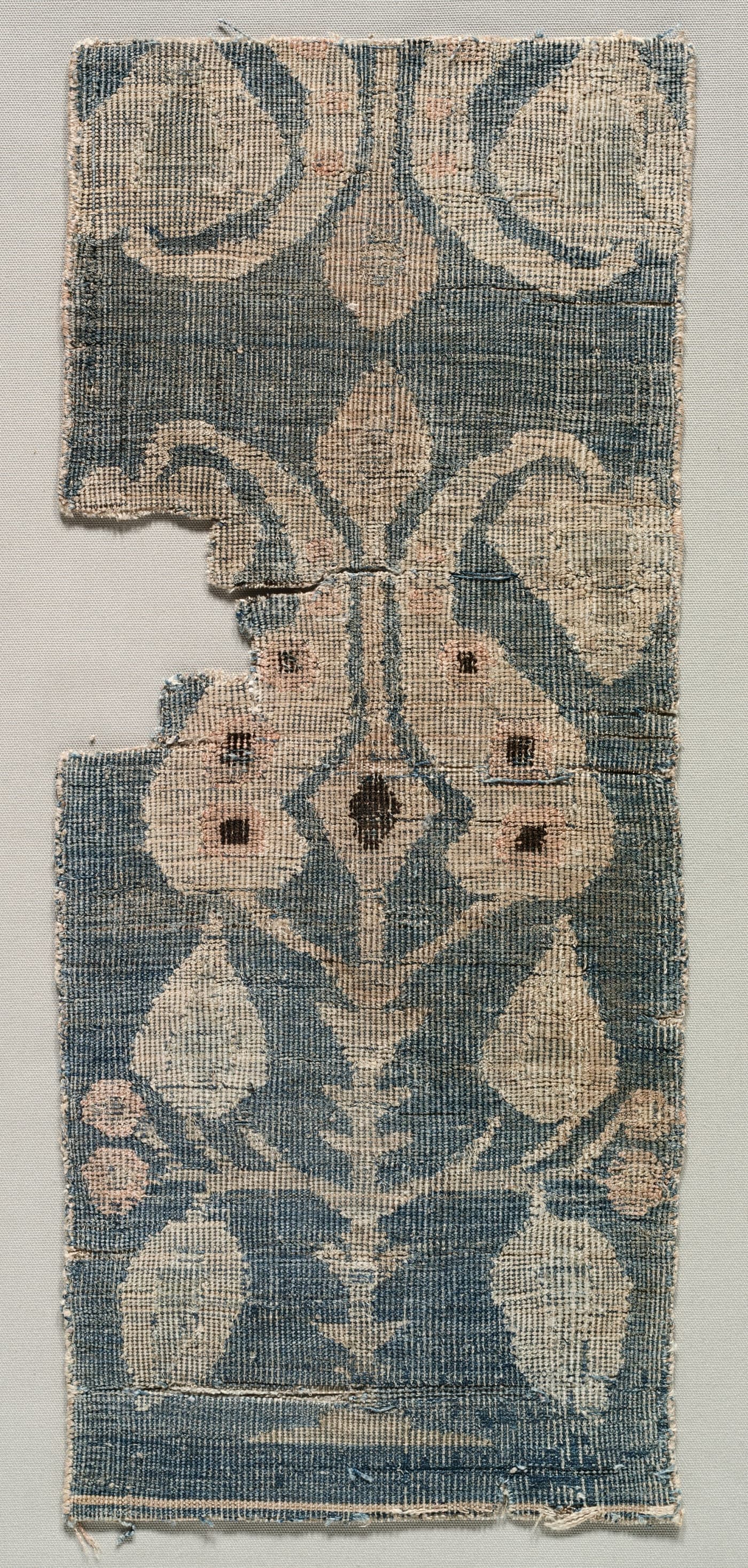
A Seljuq-period fragment, roughly 12th century — three or four hundred years before the Safavid workshops. Fragments like this are most of what survives from before 1500, which is why the record of early weaving is read from a handful of pieces and a great many paintings.
senna knot
Cleveland Museum of Art, 1966.132 · Gift of Mr. and Mrs. Werner Abegg · CC0
Court patronage and the Safavid workshops
The Safavid period, from 1501, is when Persian weaving became something other than a regional craft. Shah Tahmasp and Shah Abbas funded workshops that employed designers, dyers and weavers as specialists, and for the first time carpets were woven from cartoons drawn by court artists rather than from patterns held in the weaver's memory.
The consequence is visible in the object. Memory-woven designs are geometric because geometry survives transmission; a curve drawn freehand on a loom drifts. Cartoon-woven designs can be curvilinear, symmetrical across a central axis, and consistent over thirty square metres. The famous Ardabil carpets, now split between London and Los Angeles, are the extreme case: a single medallion design executed at roughly 300 knots per square inch across more than thirty square metres.
The court-workshop evidence and the surviving carpets are examined in the Safavid-period guide; a modern rug in a Safavid-style pattern is not evidence that it was woven in that period.
This is also when the two weaving worlds described in the Persian rugs overview diverged. Workshop production and tribal production have run in parallel ever since, and confusing their standards remains the most common error in judging a Persian rug's value.
Collapse and revival
The Afghan invasion of 1722 ended Safavid patronage, and Persian weaving fragmented back into village and tribal production for most of the eighteenth century. There is a real gap in the record — comparatively little survives, and what does is mostly provincial.
The revival came from outside. From roughly the 1870s, European and American demand rebuilt the industry as an export business. Firms such as Ziegler & Co. commissioned production in Sultanabad to Western taste: softer palettes, all-over designs, sizes matched to European rooms. Those rugs are now sought after in their own right, which is a useful reminder that "made for export" is a description, not an insult.
What this means for a buyer
Three practical consequences follow from the history, and all three affect price.
| Period | What survives | Market position |
|---|---|---|
| Pre-1800 | Fragments, museum pieces | Effectively not a retail market |
| c. 1800–1900 | Tribal and village weaving, Ziegler-type commissions | The genuine antique market |
| c. 1900–1950 | Wide range, much of it export production | Where most "antique" claims actually sit |
| Post-1950 | Commercial production, synthetic dyes common | Judged on quality, not age |
The word antique has a working definition of a hundred years or more, which in 2026 means pre-1926. A great deal of stock described as antique is inter-war or later. Establishing which you are looking at is a matter of construction and dye evidence rather than paperwork — the tests are set out in how to identify Persian rugs.
The regional traditions this produced
By the end of the nineteenth century the named regional styles were fixed, and they are still the vocabulary the trade uses. Tabriz, Kashan, Isfahan, Nain, Qum, Heriz, Bijar, Kerman, and the tribal groups — Qashqai, Bakhtiari, Baluch, Afshar — each carry a distinct set of expectations about knot type, density, palette and drawing.
Those distinctions are covered in types of Persian rugs.
1 guide in this section
- Safavid Carpets — The two centuries when Persian weaving became a court art — designed by named artists, woven at extraordinary density, and still the benchmark for everything since.
Common questions
What is the oldest surviving carpet?
The Pazyryk carpet, excavated from a frozen Scythian burial mound in the Altai Mountains in 1949 and dated to roughly the fifth century BC. It is not Persian, but its knot density — around 200 knots per square inch — shows the technique was already mature 2,500 years ago.
When did Persian weaving peak?
The Safavid period, roughly 1501 to 1736, produced the carpets that museums now compete for. Royal workshops at Tabriz, Kashan and Isfahan worked from designs by court artists, which is when carpet design became a formal discipline rather than an inherited pattern vocabulary.