
A Persian rug is a rug woven in Iran. That is the whole definition, and almost every confusion in the market comes from people using the phrase to mean something else — a style, a look, a price bracket, or a vague impression of age.
The distinction matters commercially. A hand-knotted rug woven in Tabriz and a hand-knotted rug woven in Lahore to the same Tabriz drawing can differ in price by a factor of three or more, and the two are routinely sold side by side with the difference obscured.
Why the tradition is treated as the benchmark
Persian weaving is not the oldest — the Pazyryk carpet, the earliest surviving knotted pile rug, is Scythian and roughly 2,500 years old. What Persia produced was the deepest continuity: an unbroken tradition of design refinement, court patronage and regional specialisation running from at least the Safavid period through to today.
That continuity produced something unusual. Most weaving cultures have a house style. Persia has dozens of them, each associated with a town or tribe, each with a recognisable palette, knot type, drawing convention and density. A person who learns the regions can often place a rug within a hundred miles without being told anything about it.
That is what identification actually consists of, and it is a learnable skill rather than a mystical one.
The two weaving worlds
Almost everything in Persian weaving falls into one of two categories, and they behave very differently as objects and as purchases.
City or workshop rugs are woven from a cartoon — a scaled drawing the weaver follows knot by knot. Tabriz, Kashan, Isfahan, Nain and Qum work this way. The results are symmetrical, finely knotted, curvilinear, and consistent. The design was authored by a designer, not the weaver.
Tribal and village rugs are woven from memory and convention. Qashqai, Bakhtiari, Baluch, Afshar and Kurdish weaving belong here. Patterns are geometric because geometry survives transmission by memory in a way that fine curves do not. Proportions drift. Colour changes mid-rug where a new dye lot began — an effect called abrash, which the trade once treated as a defect and now often treats as a selling point.
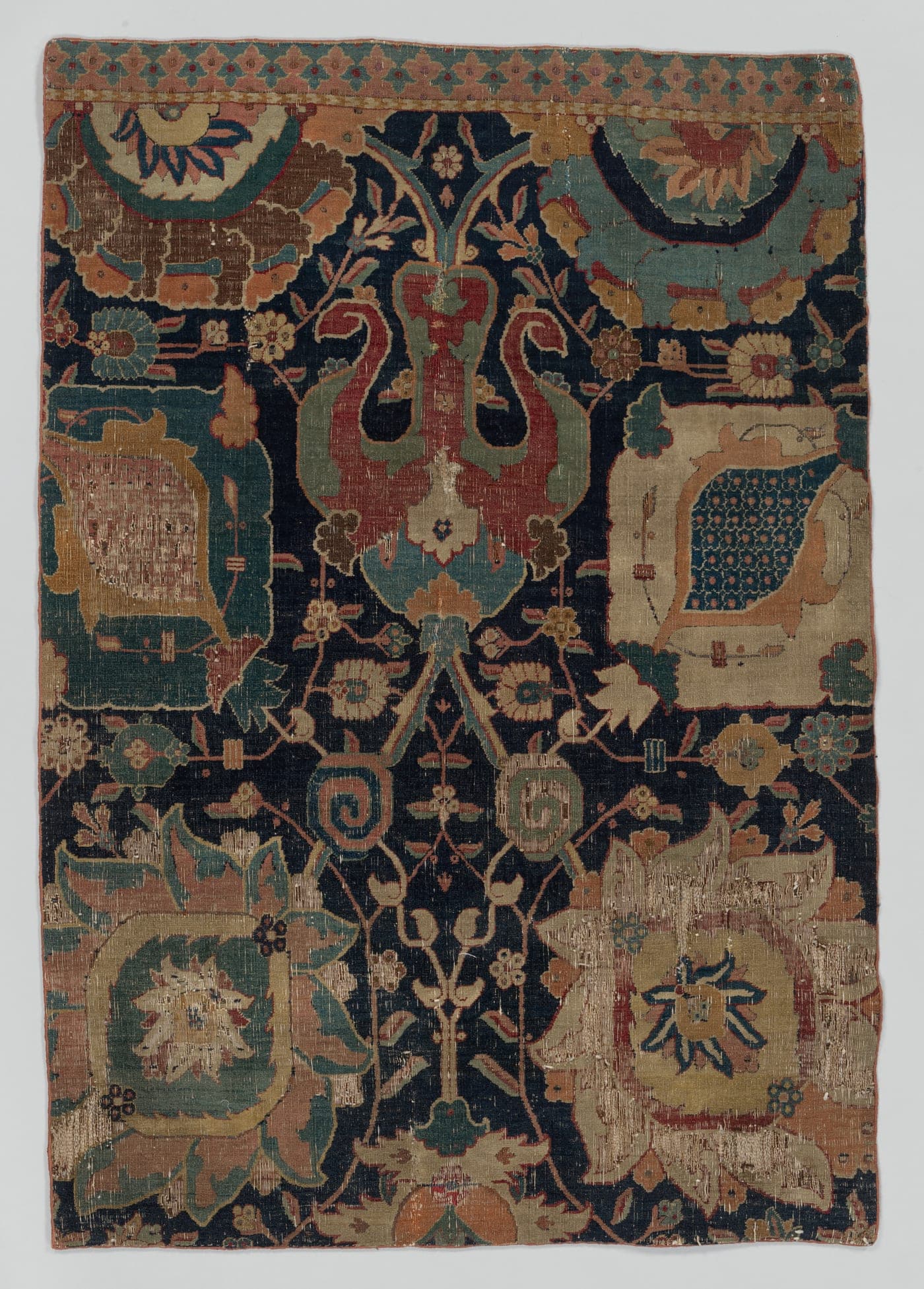
Kerman, city weaving at its most disciplined — the vase-carpet layout, drawn from a cartoon and resolving exactly across the field.
senna knot: wool and cotton
Cleveland Museum of Art, 1922.349 · Gift of M. & R. Stora · CC0
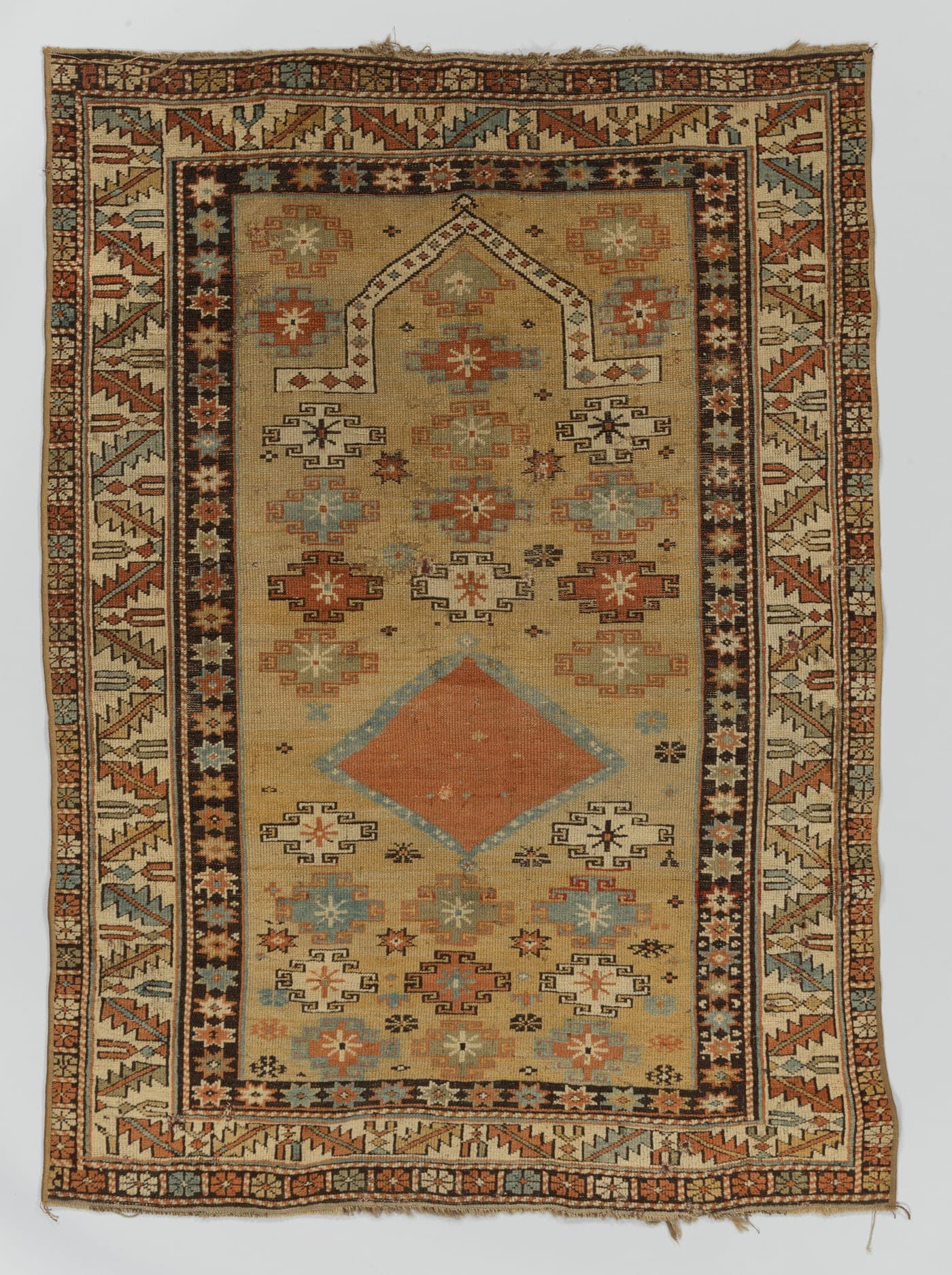
And the other world. Look at the ground: it changes tone in horizontal bands where the weaver reached the end of one dye lot and started the next. That is abrash, it is the signature of small-batch dyeing, and it is the thing a workshop existed to prevent.
Wool: Ghiordez knot
Cleveland Museum of Art, 1961.390 · Florence and Charles Abel Oriental Rug Collection · CC0
Neither is better. They are different products, and a great deal of bad buying advice comes from applying the standards of one to the other. Knot count is a reasonable quality signal in a Kashan and close to meaningless in a Qashqai.
What drives the price
Six things, in roughly descending order of influence:
| Factor | Effect on price | Notes |
|---|---|---|
| Age and originality | Very high | Genuine antiques with intact pile and no reweaving |
| Condition | Very high | Low pile, moth damage and crude repair each cut value hard |
| Weaving quality | High | Knots per square inch, but only within a comparable type |
| Origin and attribution | High | A documented Isfahan outsells an unattributed one substantially |
| Materials | Moderate | Hand-spun wool and natural dye over machine-spun and synthetic |
| Size and colour | Moderate | Commercially awkward sizes and unfashionable palettes sell for less |
Note what is absent from that list: the story. The provenance narrative offered in a shop carries no weight at appraisal unless it is documented, and it very rarely is. Treat it as decoration.
There is more detail on all six in the guide to what Persian rugs are worth.
Buying without being sold to
The single most useful habit is to separate the two questions a salesperson tends to merge: what is this object and what should it cost. Establish the first completely before discussing the second.
For the object, you want: where it was woven, roughly when, what the pile and foundation fibres are, whether the dyes are natural or synthetic, and what restoration it has had. Those five answers are checkable. A dealer who cannot or will not give them plainly is telling you something useful.
The buying guide works through the inspection in order, including the tests you can run in a shop without any equipment.
Living with one
Persian rugs are, contrary to their reputation, robust. A hand-knotted wool rug is constructed to be walked on for a century. The things that actually destroy them are avoidable: moths in storage, sustained damp, direct sun on one section, and aggressive cleaning.
Wool's natural lanolin resists soiling well enough that vacuuming and occasional professional washing is the entire maintenance regime for most rugs. What ruins them is usually enthusiasm — steam cleaners, bleach-adjacent products, and hot water on natural dyes. The care guide covers the specifics.
A rug pad matters more than most owners expect. It prevents the foundation from grinding against a hard floor, which is the main cause of wear from underneath rather than above.
Going deeper
The long view is in the history of Persian rugs — five centuries from the Safavid court workshops to the present, and why the sixteenth century still sets the standard. Its centrepiece is the Safavid period, when carpet weaving became a designed art rather than a craft.
For the visual language — what a boteh is, why a medallion sits where it does, what a garden layout is actually depicting — see Persian rug patterns.
For the city that gave the trade its commercial backbone and its most copied name, Tabriz rugs.
And if the rug in question is genuinely old, antique Persian rugs covers what "antique" means when applied honestly, and the evidence that supports an age claim rather than the story attached to it.
Everything on persian rugs
The 8 areas this subject divides into, and the guides beneath each.
- The History of Persian Rugs — How Persian weaving developed from nomadic craft to court art and back into a global export trade, and why that history still sets prices today.
- Types of Persian Rugs — The named Persian weaving regions and what actually distinguishes them — knot type, density, palette and drawing — rather than the marketing shorthand.
- Persian Rugs: Patterns & Motifs — The recurring designs in Persian weaving — medallion, herati, boteh, garden and vase — what each depicts and which regions are associated with them.
- Persian Rugs: Colors & Dyes — Traditional Persian palettes, the dyestuffs behind them, and how colour ages — the most reliable evidence of a rug's real date.
- What Persian Rugs Are Worth — How Persian rugs are actually appraised, which factors move price and by how much, and why the story a seller tells you carries no weight at valuation.
- How to Buy Persian Rugs — A working process for buying a Persian rug — what to establish before price comes up, what to inspect, and the sales tactics worth recognising early.
- How to Identify Persian Rugs — The physical tests that establish what a rug actually is — knot type, foundation, dye evidence and finishing — none of which require equipment or expertise.
- Caring for Persian Rugs — What actually keeps a hand-knotted rug alive for a century — and the small number of well-meant habits that destroy them faster than any amount of foot traffic.
Browse by
Guides written to a single dimension — colour, size, weave, age.
Size: 8×10 Persian Rugs
Age: Antique Persian Rugs
Color: Blue Persian Rugs
Weave: Hand-Knotted Persian Rugs
Every guide in Persian
All 16 articles in this section, starting with the ones we would hand someone new to it.
- How to Buy Persian Rugs — start here
- How to Identify Persian Rugs — start here
- What Persian Rugs Are Worth — start here
- 8×10 Persian Rugs
- Antique Persian Rugs
- Blue Persian Rugs
- Caring for Persian Rugs
- Hand-Knotted Persian Rugs
- Kashan Rugs
- Persian Rugs: Colors & Dyes
- Persian Rugs: Patterns & Motifs
- Qashqai Rugs
- Safavid Carpets
- Tabriz Rugs
- The History of Persian Rugs
- Types of Persian Rugs
Common questions
What makes a rug genuinely Persian?
A Persian rug is one woven within the borders of modern Iran. The term is geographic, not stylistic. A rug woven in Pakistan to a Tabriz design is a Persian-design rug, not a Persian rug, and the price difference between the two is substantial.
Are Persian rugs a good investment?
Usually not, in the financial sense. Only the top few percent — antique, documented, exceptional condition — appreciate reliably. A new commercial Persian rug typically loses value the moment it leaves the shop, in the same way most furniture does. Buy one because you want to live with it.
How can I tell a hand-knotted Persian rug from a machine-made copy?
Turn it over. A hand-knotted rug's pattern is as clear on the back as the front, and the knots are visibly irregular. Machine-made rugs have a uniform, gridded reverse, often with a stiff backing, and the fringe is usually sewn on rather than being the warp threads themselves.