
The Safavid dynasty ruled Iran from 1501 to 1736, and the carpets produced under its patronage are the reason Persian weaving is treated as the benchmark tradition rather than one regional craft among many.
What changed
Before the Safavids, carpets were woven from inherited pattern vocabulary held in a weaver's memory. Under Shah Tahmasp and later Shah Abbas, the court funded permanent workshops staffed by specialists — designers, dyers, and weavers working separately — and carpets began to be woven from cartoons drawn by court artists.
The effect on the object is immediate and visible. Cartoon-woven design can be curvilinear, exactly symmetrical, and consistent across enormous surfaces. Memory-woven design cannot, which is why tribal weaving is geometric. This is the origin of the two weaving worlds described in the Persian rugs overview.
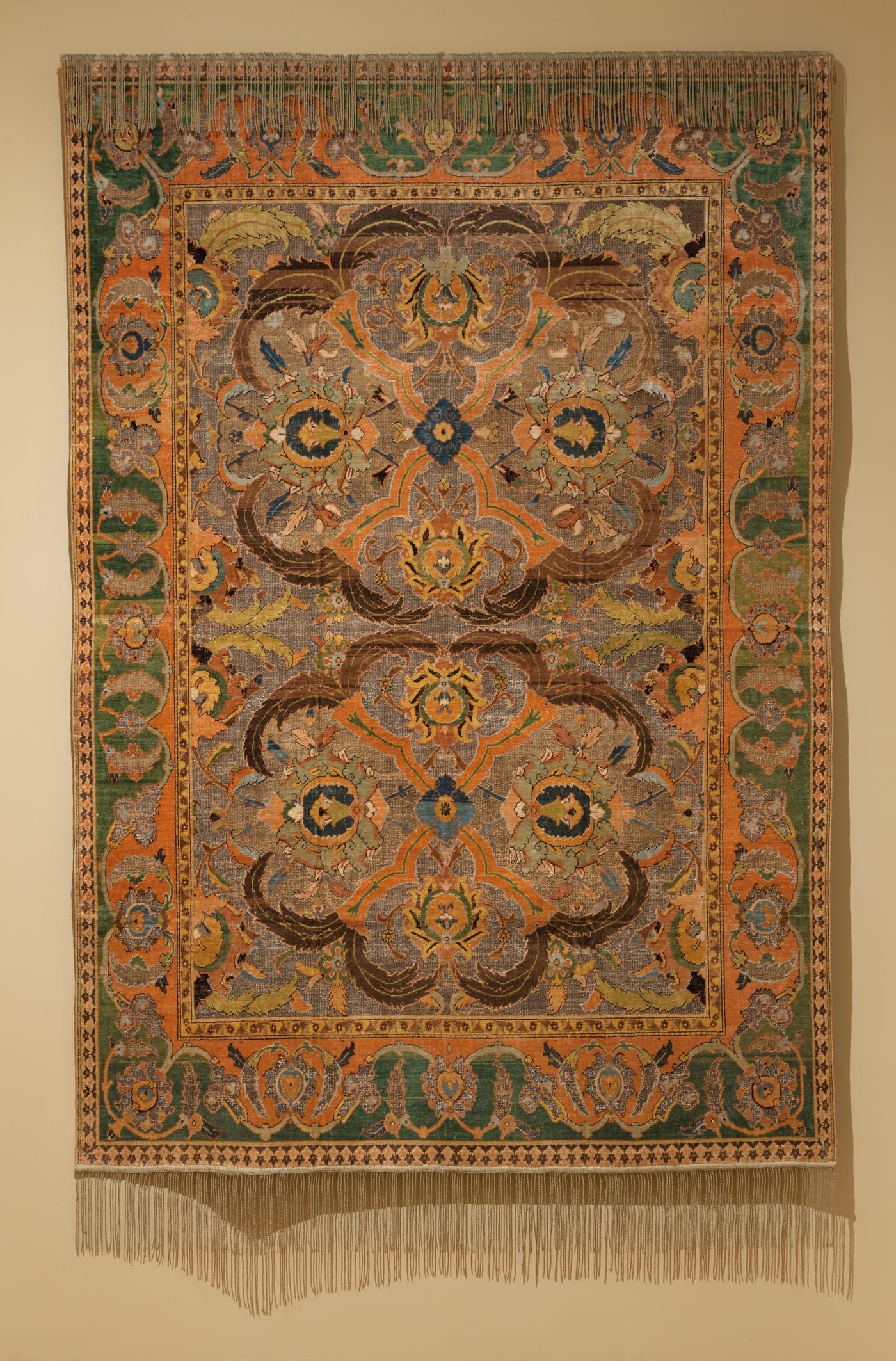
Isfahan under Shah Abbas. Silk and metal thread on a cotton foundation, asymmetric knot — every one of those is a workshop decision rather than a village one, and none of it is possible without a designer, a dyer and a weaver working as separate trades.
Cotton: warp; cotton and silk: wefts; silk: pile, asymmetrical knot; gilt- and silver-metal thread: brocaded
Cleveland Museum of Art, 1926.533 · Purchase from the J. H. Wade Fund · CC0
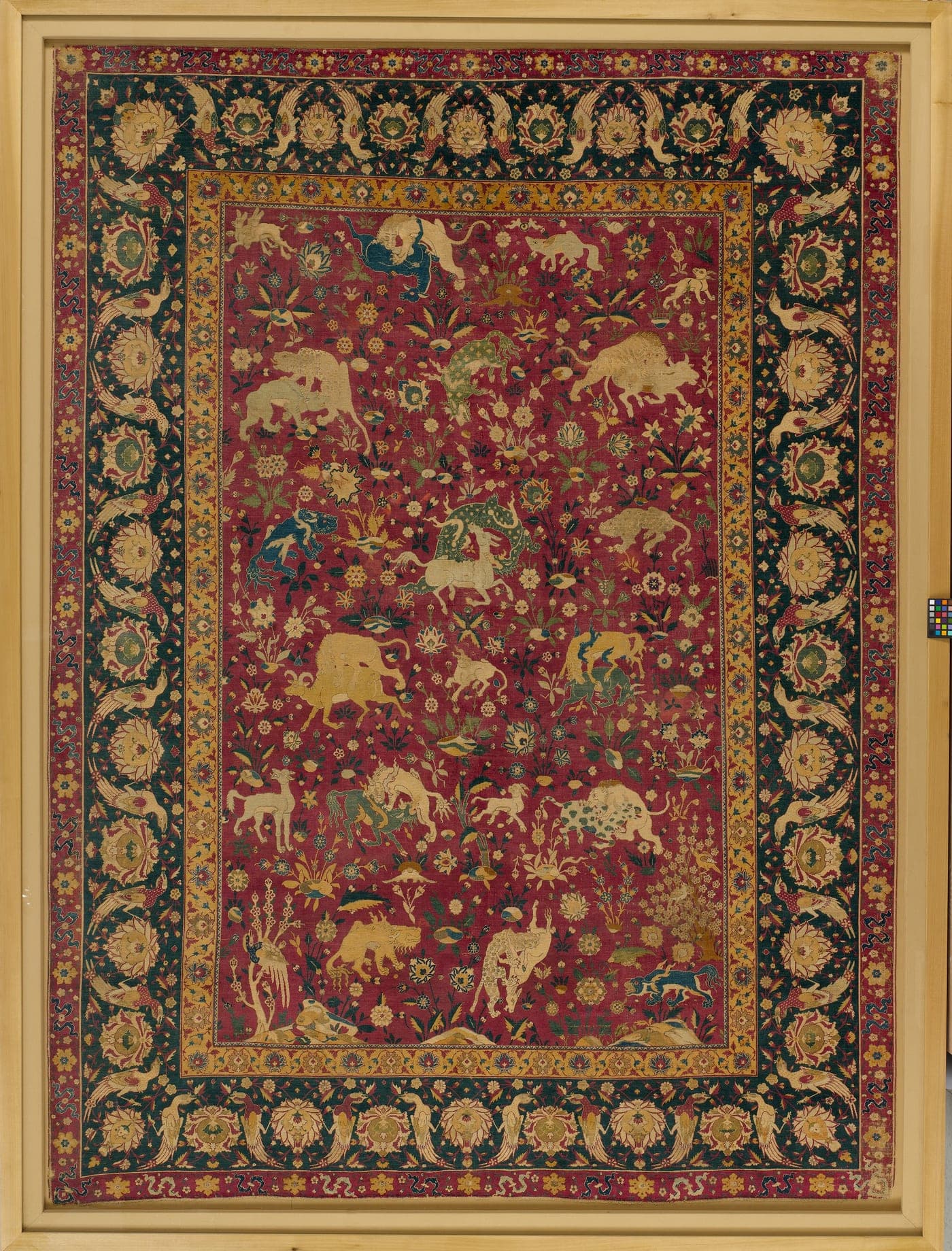
What a cartoon buys you: animals drawn in the round, vines that bend continuously, and a composition that resolves across the whole field rather than repeating. Compare it against any tribal weaving and the difference is not skill — it is whether someone drew the design first.
Silk (warp, weft, and pile); asymmetrically knotted pile
The Metropolitan Museum of Art, 14.40.721 · Bequest of Benjamin Altman, 1913 · Public Domain (CC0)
The Ardabil carpets
The pair known as the Ardabil carpets, dated 1539–40, are the most documented Safavid survivals. One is in the Victoria and Albert Museum in London, the other in the Los Angeles County Museum of Art.
They carry an inscription — a couplet from Hafez plus the name Maqsud Kashani and a date — which makes them one of the very few carpets in existence with a firm date and a named hand. The London example measures over ten metres by five and is woven at roughly 300 knots per square inch. That is somewhere near twenty-six million knots.
The design is a single central medallion with sixteen pendants, two mosque lamps of deliberately unequal size, and a field of arabesques on deep indigo. The unequal lamps are usually explained as a perspective correction for a viewer standing at one end.
The design vocabulary that survived
Most of what the trade now calls classical Persian design was fixed in this period:
- The central medallion with corner spandrels, still the dominant format
- The arabesque, an infinitely extensible interlacing vine
- The Herati pattern, a rosette between two curved leaves, still woven everywhere
- Garden carpets, laying out a formal quadripartite garden in plan
- Hunting carpets, with figures and animals in a landscape
These are why Kashan, Tabriz and Isfahan production today looks the way it does — see types of Persian rugs.
Why this matters to a buyer
Almost never directly, and that is the point. Genuine Safavid carpets are museum objects, and the small number that reach the market do so at prices that put them outside any normal discussion of buying a rug.
What matters is the vocabulary. When a dealer describes a rug as a "Shah Abbas design" or a "classical medallion", they are describing a design lineage that originates here, executed in the twentieth or twenty-first century. That is a perfectly honest description. It becomes dishonest only when the lineage is allowed to imply age.
Distinguishing a revival from the thing revived is a matter of construction and dye evidence — identification — and it is the difference between four figures and seven.
Common questions
Can you still buy a Safavid carpet?
Only at the very top of the international auction market, and rarely. Surviving examples are overwhelmingly in museums. What is sold at retail as "Safavid" is almost always a later revival of a Safavid design, which is a legitimate category but a completely different object.