
Motifs are the vocabulary that sits inside the layouts described in rug patterns. A handful of them account for most of what you will ever see.
The ones worth knowing
- Boteh
- Teardrop with a curved tip — the origin of paisley
- Herati
- Rosette in a diamond with four curved leaves. Everywhere.
- Gul
- Octagonal medallion repeated in rows — Turkmen tribal marker
- Tree of life
- A single tree rising from the base, often in prayer rugs
- Mihrab
- The arch of a prayer rug; directional by definition
- Shou
- Chinese longevity character, used as a medallion
- Latch-hook
- Stepped hooks on a medallion edge — Caucasian and tribal
Boteh is a widely travelled motif in textile history. Its early route and origin are debated; the shape was carried west on Kashmiri shawls and mass-reproduced in Paisley, Scotland, giving it a Western name. Proposed readings include a cypress, a flame or a sprouting seed, but no single explanation is established.
Herati is the most common. Once you can see it you will find it everywhere: a small rosette inside a diamond frame, with four curved leaves around it. The leaves are usually described as fish, which is a nineteenth-century Western reading rather than a Persian one.
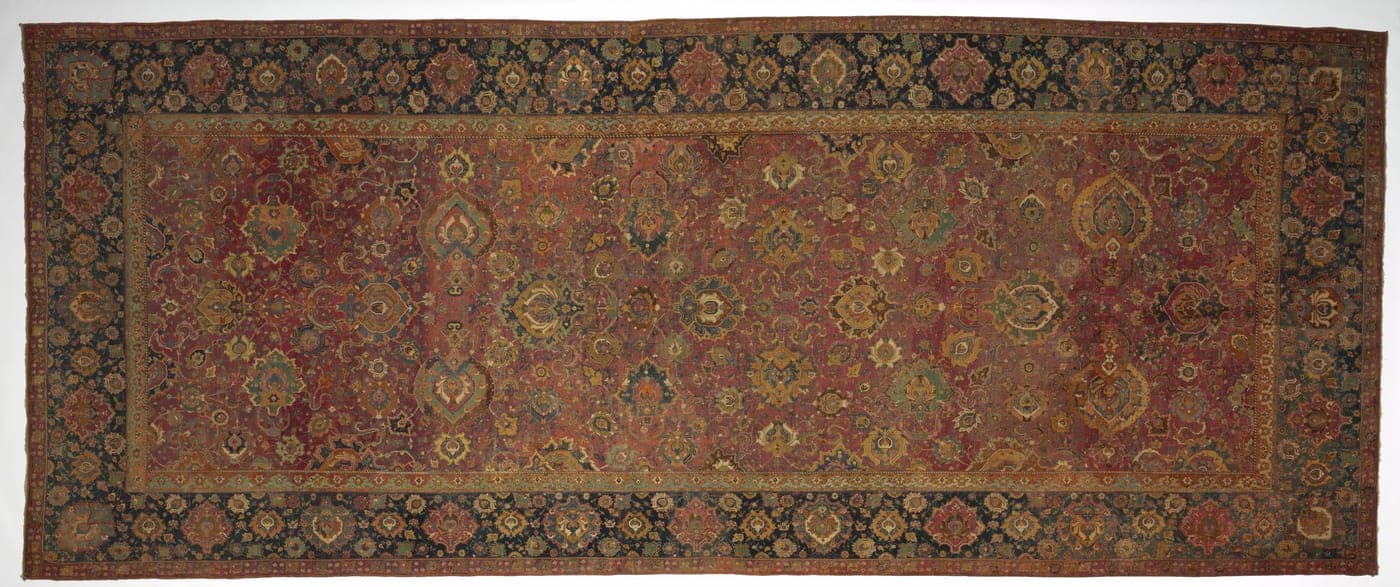
Herat, which gave the pattern its name. Seeing it at source is the fastest way to learn it — the rosette, the diamond frame implied rather than drawn, and the four curved leaves that later became 'fish' in English catalogues.
senna knot: wool and cotton
Cleveland Museum of Art, 1962.263 · Florence and Charles Abel Oriental Rug Collection by exchange · CC0
Gul patterns are strongly associated with Turkmen weaving groups and can offer attribution clues. Forms were also copied, so a gul is not a unique signature on its own — see Turkmen rugs.
Regional vocabularies
Motifs cluster by tradition, and knowing which belongs where helps place a rug:
- Persian — herati, boteh, shah abbasi palmette, arabesque, cloud band
- Turkish — mihrab, elibelinde (the hands-on-hips figure), ram's horn, star
- Caucasian — large latch-hooked medallions, stylised dragons, geometric animals
- Turkmen — guls, minor guls, ertmen and kepse variants
- Chinese — shou, fu, bat, peach, crane, cloud band, fret border
The Chinese set is the only one where the meanings are firmly documented rather than reconstructed. See chinese rugs.
On stated meanings
Be sceptical of the shop version
A great deal of the symbolism recited in rug shops was written for Western buyers in the twentieth century. Some motif meanings are genuinely traditional and traceable; many are not, and the confident ones are often the least supported. Where the evidence is thin, a motif is better described as conventional than as meaningful.
This is covered properly in rug symbolism, including which claims hold up and which do not.
For a closer look at the evidence behind the boteh, tree imagery and Turkmen guls, read what rug motifs mean — and what they don't.
Why motifs matter commercially
Less than construction and condition, but two ways:
Attribution. Motif vocabulary is a real identification signal. A gul places a rug in the Turkmen family; a mihrab suggests Anatolia; a herati field is Persian or Persian-derived. It narrows the question that identification then settles from construction.
Saleability. Some motifs date a rug in the market's eye. Dense herati fields in deep madder read traditional; open fields and large-scale drawing read contemporary and currently sell more easily. That is fashion rather than quality, and it is why comparable rugs in different vocabularies fetch different prices — see rug value.
Every guide in Motifs
All 1 article in this section, starting with the ones we would hand someone new to it.
- What Rug Motifs Mean — and What They Don't — start here
Common questions
What is a boteh?
The teardrop with a curved tip that Western textiles call paisley — the name comes from Paisley in Scotland, where Kashmiri shawls carrying the motif were mass-produced in the nineteenth century. The motif itself is Persian and considerably older.
What is the herati pattern?
A rosette inside a diamond, flanked by four curved leaves often described as fish. It is the single most widespread motif in the rug world, appearing across Persian, Turkish, Caucasian and Indian weaving, and it fills a field as an all-over repeat.