
Turkmen weaving is the most disciplined design system in the tribal rug world. A narrow palette, a repeating medallion, and a set of rules strict enough that the motif tells you which tribe held the loom.
The gul
The field of a Turkmen rug is a lattice of repeated octagonal medallions called guls, usually with a secondary minor gul between them. Each tribal confederation used its own gul form, and the differences are consistent enough to function as attribution.
- Tekke
- The most common; quartered gul, fine weave, deep red
- Salor
- The most prized; large gul with trefoil pendants, silk highlights
- Yomut
- More varied; kepse and dyrnak guls, often aubergine ground
- Ersari / Beshir
- Larger scale, looser drawing, wider palette
- Chodor
- Distinctive ertmen gul in diagonal rows
- Saryk
- Dark, dense, often with cotton and silk highlights
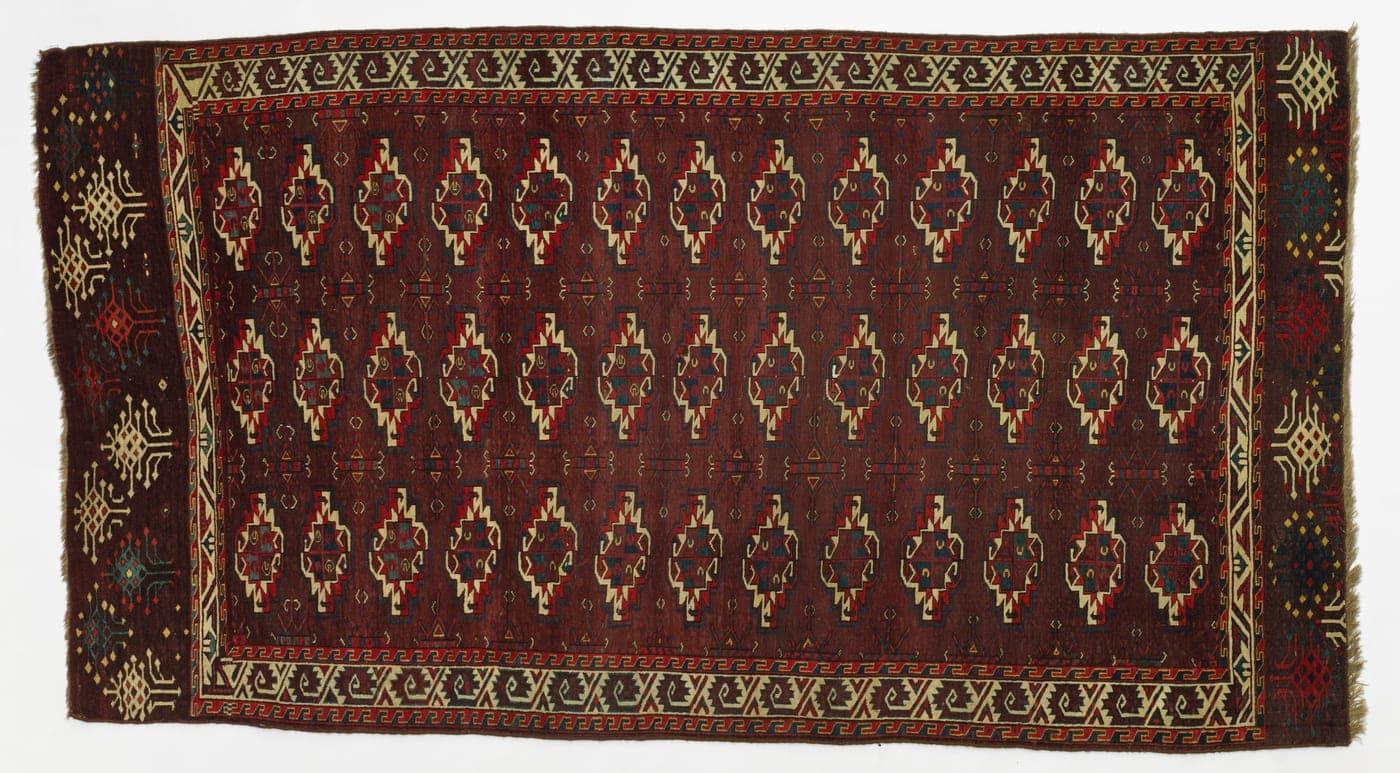
A Yomud main carpet. The whole design system is one motif repeated under discipline — no medallion, no focal point, and the interest carried entirely by rhythm and small variation between guls.
Wool, knotted pile, 128-136 symmetrical knots per square inch
Cleveland Museum of Art, 2010.190 · Gift of E.B. and Joan C. Long · CC0
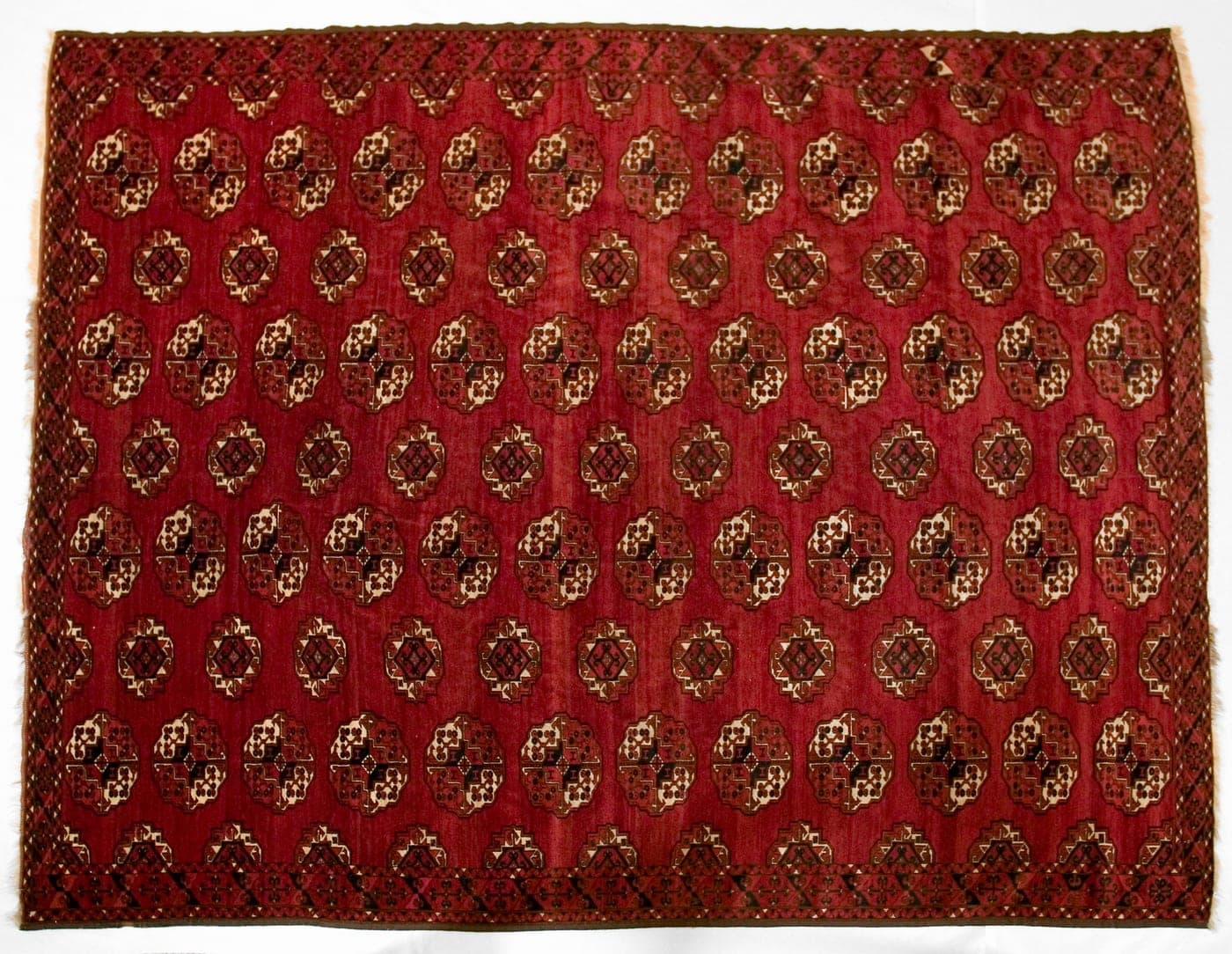
Saryk weaving, recorded by the museum at 171 symmetrical knots per square inch. That figure is worth holding onto next time a dealer offers knot count as a quality score — this is tribal weaving at a density most commercial city rugs never reach.
Wool, silk; 171 symmetrical (Turkish) knots per square inch
Cleveland Museum of Art, 2006.201 · Gift of Arlene C. Cooper · CC0
This is where the "Bokhara" name comes from. Bokhara was the market city where these rugs were traded, not where they were woven, and the design is now reproduced in volume in Pakistan. The Pakistani Bokhara guide explains how to separate that commercial design name from a rug's provenance.
Beyond carpets
Turkmen weaving is largely not carpets. Nomadic households produced a whole functional textile vocabulary, and these are what collectors chase:
- Torba and mafrash — storage bags hung inside the yurt
- Chuval — larger storage bags
- Asmalyk — pentagonal camel flank trappings for wedding processions
- Ensi — yurt door rugs, often mistaken for prayer rugs
- Germech — the strip laid at the yurt threshold
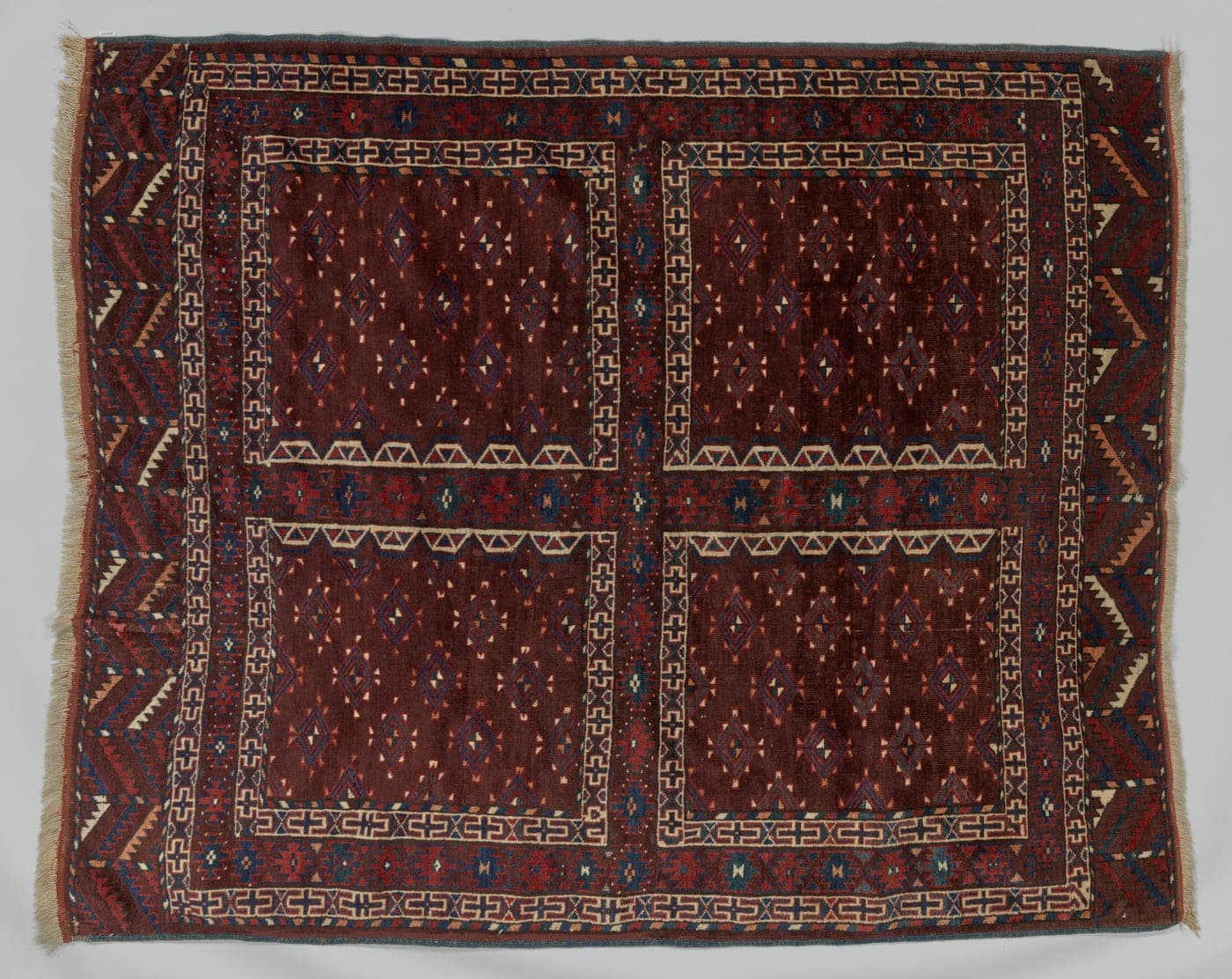
An ensi — a yurt door rug. The quartered layout is frequently mistaken for a prayer rug in Western sale rooms, and the mistake is worth knowing about because it changes what the object is: this hung in a doorway and was made to be lifted, not knelt on.
knotted pile, asymmetrical knot, 117 knots psi; wool
Cleveland Museum of Art, 2010.191 · Gift of E.B. and Joan C. Long · CC0
Small formats, extremely fine weaving, and often better material than the room-size carpets. They are also the affordable way into the tradition.
Judging
Turkmen weaving rewards close attention more than almost any other category, because quality differences sit in details that are easy to miss.
Check the gul drawing for consistency — a well-woven rug keeps the lattice regular across the whole field. Check the wool: good Turkmen wool is lustrous and takes madder to a depth that later production does not reach. Check for silk and cotton highlights, which appear in the best pieces as small accents rather than as fields.
And check the date honestly. Synthetic dye reached Central Asia in the late nineteenth century, and the drop in quality after roughly 1900 is real and steep. The dye tests are in identification, and the age threshold in antique rugs.
Start small
A good nineteenth-century torba or chuval costs a fraction of a room-size carpet and frequently shows better weaving. It is the most efficient way to learn what quality looks like in this tradition.
Living with one
The narrow red palette is the practical consideration. Turkmen rugs are emphatic, and they work best where that is the point — a study, a hallway, a room with restrained furniture — rather than as a neutral ground.
They are also, in good condition, extremely hard-wearing. Dense construction and excellent wool, in the same way Afghan rugs inherited from the same tradition. Standard care applies: rug cleaning and rug pads.
Common questions
What is a gul?
The octagonal or lozenge medallion repeated in rows across a Turkmen field. Each tribe used its own gul form, and the shape functions almost as a maker's mark — a Tekke gul, a Salor gul and a Yomut gul are distinguishable and identify the group that wove the rug.
Why are Turkmen rugs almost always red?
Madder, in a deep range from brick to aubergine, was the dominant ground colour across the whole tradition. The restraint is deliberate: Turkmen weaving works through repetition and small variation within a narrow palette rather than through colour contrast.