
Before the motifs, there is the structure. Almost every knotted rug ever made is organised by the same few layouts, and recognising them is the fastest way to start reading a rug.
The anatomy
Every classical rug has the same parts, and the vocabulary is worth having:
- Field — the central area, the rug's ground
- Border — the frame, usually one main band with narrower guard stripes each side
- Medallion — a central form, when there is one
- Spandrels — the corner pieces, usually quarters of the medallion
- Guard stripes — the narrow bands flanking the main border
A rug where the border overwhelms the field, or where the corners do not resolve, is telling you something about the weaver and the workshop.
The layouts
- Medallion
- Central form with corner spandrels — the classic city layout
- All-over
- A repeating motif across the whole field, no centre
- Garden / compartment
- A grid of panels, each with its own contents
- Prayer
- Directional, with a mihrab arch pointing one way
- Pictorial
- A scene — hunting, garden, figures, architecture
- Open field
- Little or no field decoration; the border does the work
Medallion dominates Persian city weaving — Kashan, Tabriz, Isfahan. It requires a cartoon, which is why it belongs to workshop rather than tribal production.
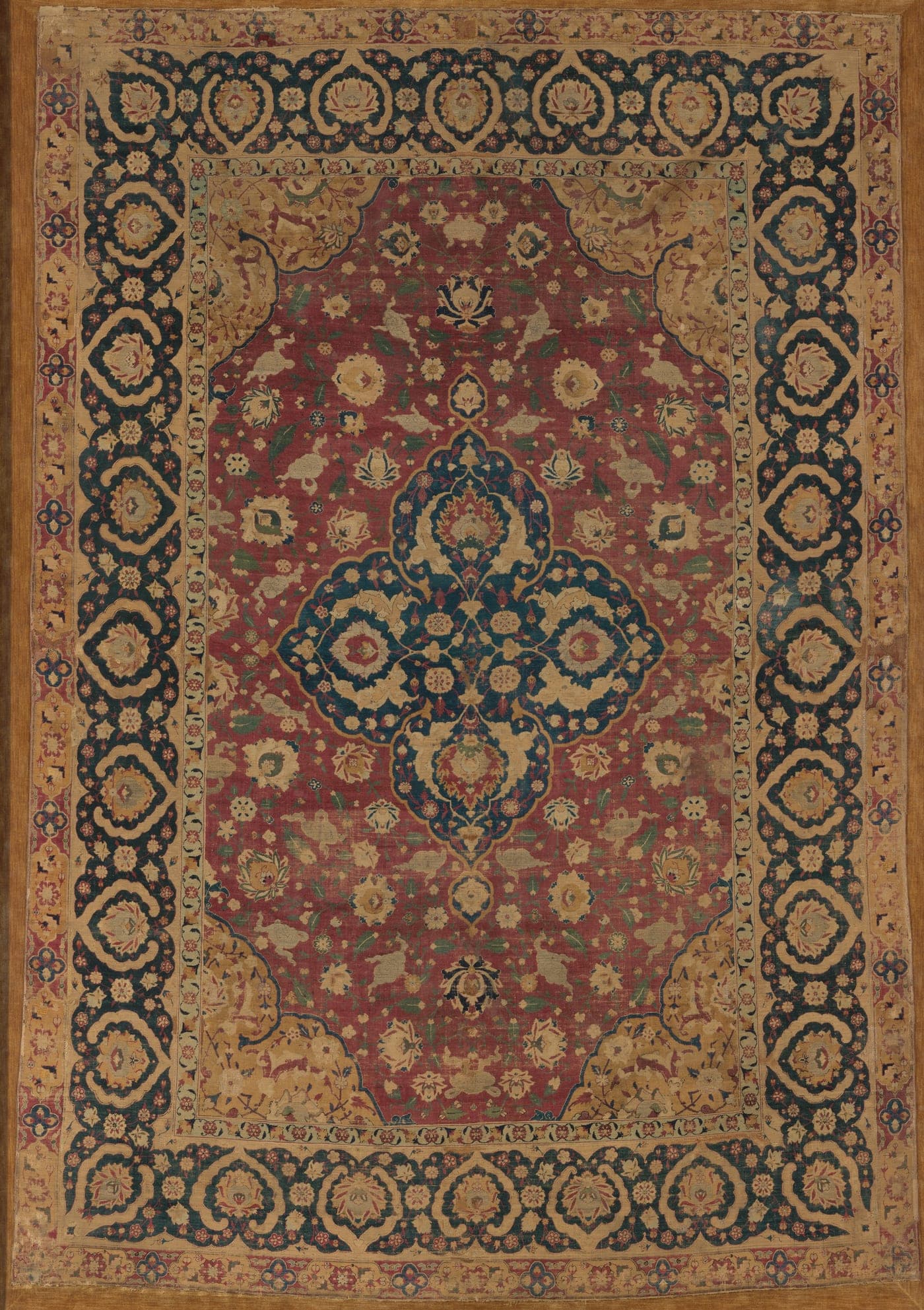
The medallion layout in its textbook form: a central form, four corner spandrels quoting a quarter of it, and a field that resolves symmetrically in both axes. Every part of that requires the design to exist on paper before a knot is tied.
Silk (warp, weft, and pile), metal wrapped thread; asymmetrically knotted pile
The Metropolitan Museum of Art, 14.40.715 · Bequest of Benjamin Altman, 1913 · Public Domain (CC0)
Pictorial weaving is the same argument taken further — a scene rather than a pattern.
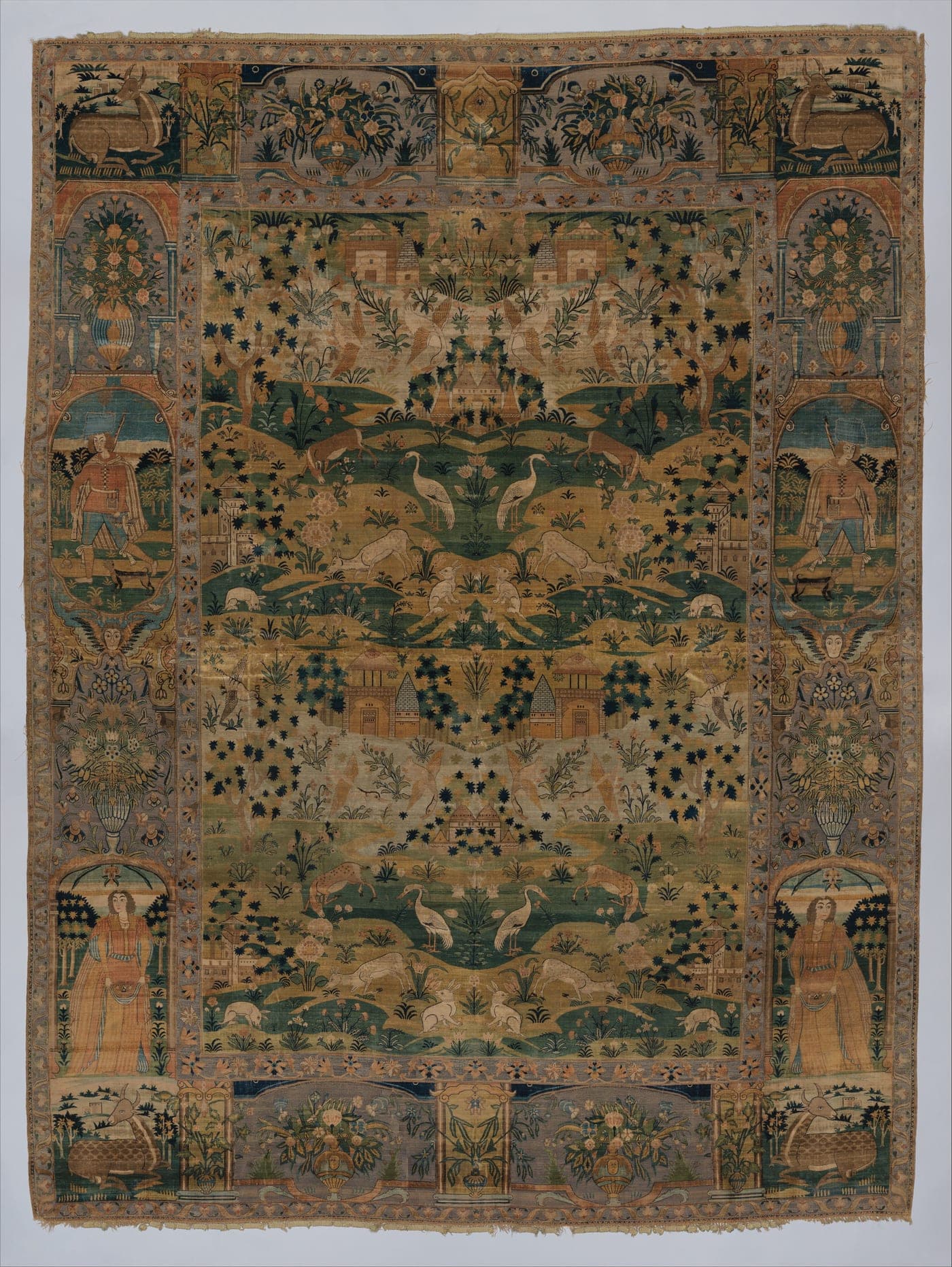
Figures overlapping, foreground and background, and shading across a curve. This is a painting executed in knots, and it is the furthest a loom gets from the repeating geometry that a weaver working from memory produces.
Silk (warp, weft, and pile), metal wrapped thread; asymmetrically knotted pile, brocaded
The Metropolitan Museum of Art, 67.2.2 · Gift of C. Ruxton Love Jr., 1967 · Public Domain (CC0)
All-over designs repeat a motif across the field with no centre, which makes them far more forgiving to place: furniture can sit anywhere without covering "the good bit". The Herati pattern — a rosette between two curved leaves — is the most widespread example in the entire rug world.
Garden or compartment layouts divide the field into panels. Bakhtiari weaving is the best-known example, and the format traces back to formal Persian garden plans.
Prayer rugs are directional, with an arched mihrab. They are the signature Anatolian format — see turkish rugs — and being directional they need thought about orientation in a room.
Choosing by room rather than by taste
The practical question is not which pattern you like but which survives your room.
All-over repeats hide soil and furniture. Both because there is no focal point to obscure and because a busy field disguises wear. They are the sensible choice for living rooms and dining rooms.
Medallions need to be seen. A central medallion under a coffee table is money spent on something nobody will look at. They suit rooms where the floor is visible — an entrance hall, a room with furniture around the edges.
Open fields show everything. Every mark, every crush, every footprint. Beautiful in a low-traffic room and punishing anywhere else.
Before you buy, mark the furniture
Lay tape on the floor where the sofa and table will sit, then look at the rug's layout against it. A great many disappointing rug purchases are the right rug in the wrong layout for the room's furniture plan.
Where patterns come from
The classical vocabulary was largely fixed in the Safavid period and has been reworked ever since — the arabesque, the Herati, the boteh, the garden plan. Individual motifs and their claimed meanings are covered in rug motifs and rug symbolism, and the colour logic in rug colors.
For contemporary design that deliberately abandons this grammar, see modern rugs; for work that continues it, traditional rugs.
Common questions
What is a medallion rug?
A rug organised around a single central form, usually with quarter-medallions repeated in the corner spandrels. It is the dominant layout in Persian city weaving and the one most people picture when they think of an Oriental carpet.
Does the pattern affect a rug's value?
Less than construction, condition and age, but it affects saleability. Designs that suit current interiors — open fields, all-over repeats, softer palettes — sell more easily than dense formal medallions, which is why comparable antique rugs in different layouts fetch different prices.