
Afghan weaving descends from the same Turkmen tradition as the great Central Asian carpets, and it produces some of the most durable hand-knotted rugs available at any price.
What you will encounter
- Khal Mohammadi
- Deep madder red, Turkmen gul repeat, dense and heavy
- Kunduz / Andkhoy
- Commercial Turkmen-design production at volume
- Baluch
- Small formats, aubergine and blue-black, prayer rugs
- Chobi / Ziegler
- Vegetable-dyed, softer palette, made for export
- War rugs
- Conflict iconography in traditional layouts
Khal Mohammadi is the workhorse: a dense, heavy rug in deep madder red carrying the octagonal gul motifs inherited from Turkmen weaving. The wool is excellent — highland fleece with high lanolin — and these rugs take decades of traffic without complaint.
Baluch weaving straddles the Afghan–Iranian border and is a genuinely distinct tradition: small, dark, often prayer-format, in aubergine, camel and blue-black. It has been undervalued for as long as anyone has been paying attention, and remains one of the cheapest routes into genuinely old tribal weaving with natural dye.
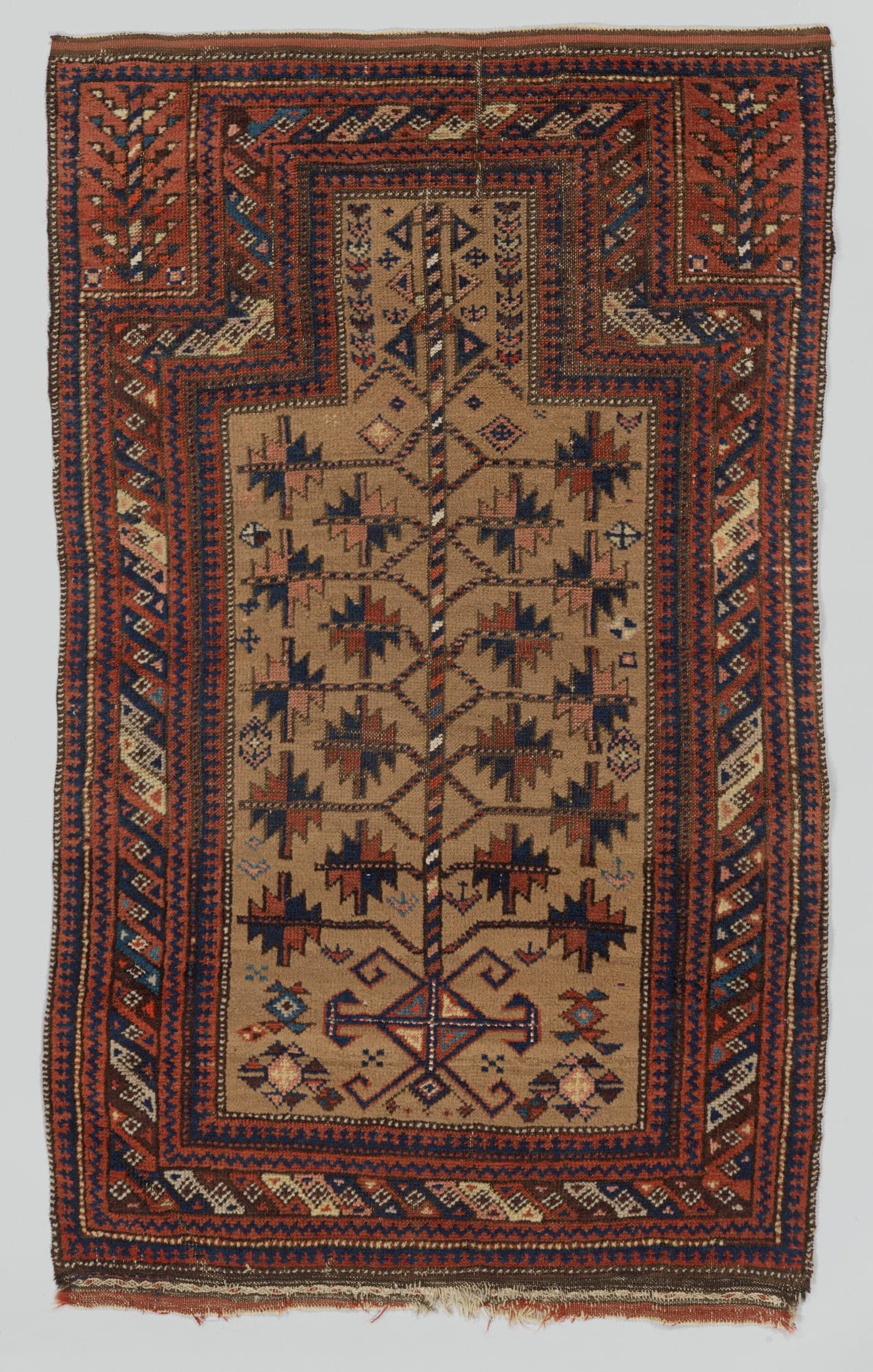
Baluch weaving from near Mashhad. The palette is the tell — aubergine and blue-black so dark the design has to be read in raking light, with camel used sparingly to carry it. Rugs like this sit unsold in shops because they photograph poorly, which is precisely why they remain cheap.
senna knot: wool, cotton, and camel hair
Cleveland Museum of Art, 1961.385 · Florence and Charles Abel Oriental Rug Collection · CC0
Chobi (also sold as Ziegler) is modern export production using vegetable dyes and a deliberately softened, washed-down palette aimed at Western interiors. Honest goods, generally decent quality, and priced accordingly.
War rugs
From 1979 onwards Afghan weavers began incorporating what they were living through: helicopters, Kalashnikovs, tanks, grenades, and later maps, drone silhouettes and World Trade Center imagery. Early examples hide the weaponry inside conventional border and gul layouts; later ones are explicit.
They are a serious folk-art category with real scholarship behind them, and they are also heavily reproduced for the collector market. An early piece with weaponry integrated subtly into a traditional structure is a different object from a 2010s rug woven to order with a tank in the middle.
Judging one
The usual sequence applies — construction, fibre, dye, age, condition — and the tests are in identification.
Two Afghan-specific notes. The wool is generally very good, so compression and lustre should be strong; dry, chalky wool on an Afghan rug is a downgrade signal. And the deep red is frequently over-washed at the finishing stage to soften it for export, which lightens the surface relative to the base of the pile in a way that can be mistaken for age.
On provenance and ethics
Afghan production has run through four decades of conflict and displacement, and much weaving now happens in refugee communities in Pakistan and Iran. A dealer who can describe where their rugs actually come from is worth preferring over one who cannot.
For the overlapping Pakistan–Afghanistan trade names, see Peshawar and Chobi rugs.
Living with one
Afghan rugs are among the most practical hand-knotted rugs you can buy. Dense construction, dark palette that hides soil, and wool that takes punishment — a good combination for entryways, dining rooms and households with animals.
The dark palette is the trade-off: a deep madder Khal Mohammadi is emphatic in a small room and does not suit every interior.
Maintenance is standard: pad, rotate, vacuum both faces, wash every three to five years — see rug cleaning and wool rugs.
Common questions
Are Afghan rugs good value?
Consistently, yes. Afghan production uses good highland wool, largely natural dye at the village level, and genuine hand-knotting, but sells below Persian and Turkish equivalents because the names carry less market weight. For durability per pound spent it is one of the better buys in hand-knotted rugs.
What is a war rug?
Afghan rugs woven from the Soviet invasion onwards that incorporate helicopters, tanks, rifles and maps into traditional layouts. They are a genuine folk response to four decades of conflict, and they are now heavily reproduced for the tourist and collector market.