
For a nursery, start with what you can check: the rug's label, its construction and backing, how you will clean it, and whether it stays flat under a child learning to walk. Fiber alone cannot tell you whether a product is low-emitting or easy to maintain.
Read the flammability label
US federal rules require a carpet or rug that has received a fire-retardant treatment, or was made from treated fibers, to be labeled with a conspicuous T. This is a specific disclosure, not a general claim that a rug is “non-toxic.” Ask the seller for a photo of the product label or the required information if an online listing omits it.
There is a second check for small rugs: a rug that fails the federal surface-flammability test may still be sold with a prescribed permanent warning. The small-rug category covers rugs no larger than 24 square feet with no dimension over six feet. Read both the treatment disclosure and any warning before making a decision. The CPSC explains both labeling rules.
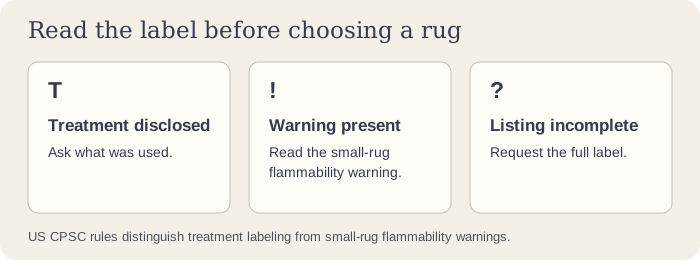
Wool is naturally flame resistant, but wool on a listing does not replace the label check. Likewise, the absence of a T on a cropped product photo does not establish what the full label says. See wool rug properties for the material's behavior rather than a blanket safety verdict.
Ask what the rug and backing contain
A woven or hand-knotted rug holds its structure with yarn. A hand-tufted rug commonly uses adhesive and a secondary backing. Machine-made rugs have several backing systems. Construction helps you ask the right question, but it does not establish a product's measured emissions: dyes, finishes, adhesives, pads and other materials also matter.
Ask for the pile and foundation fibers, the backing material, any applied stain or fire treatment, and a product-specific emissions result if low emissions are a priority. A new-rug smell is not a chemical test. The US EPA notes that new carpet systems can emit VOCs and recommends selecting low-emission products and ventilating after installation. Airing a new rug in a well-ventilated space before use is sensible; there is no universal number of hours that makes every product emission-free.
Read certifications for their actual scope
| Label | What it helps you check | What it does not settle |
|---|---|---|
| UL GREENGUARD Gold | The certified product meets specified chemical-emission limits | Every possible exposure or the rug's cleanability |
| OEKO-TEX STANDARD 100 | Tested textile components meet limits for listed harmful substances | A measured room-air emission level |
| GOTS | Organic fiber and controlled textile processing across its certified scope | A substitute for an emissions test on every finished rug |
Check that the specific rug carries a valid certification, not merely that the brand sells some certified products. A rug without these marks is not automatically unsafe; the marks answer narrower questions than the marketing around them often does. The issuing organizations explain the scope of GREENGUARD Gold and STANDARD 100.
Make floor-level care practical
The EPA notes that carpet can hold dust and that young children may contact material left in it while playing. Choose a surface you can maintain, vacuum it according to its construction, and clean spills promptly without leaving the rug or floor damp. The cleaning guide explains how method changes with fiber and backing.
- Grip
- The rug and pad should stay flat when a child moves over them
- Pile
- A low or medium profile is easier to inspect for small objects
- Care
- Follow the label; machine-washable is product-specific
- Drying
- Dry the rug and floor after a spill or wash
For frequent spills, a machine-washable rug or a small cotton flatweave can be convenient if it fits your washer. Wool may be a better long-term choice if you want a softer pile and accept more involved care. Neither choice has a guaranteed lifespan. Avoid choosing a thick, loose pile only for its showroom softness if toys, crumbs and cleaning will be daily concerns.
Use a pad compatible with the actual floor, and check that the assembled rug does not slide or curl. Pad material by itself is not a verified emissions result; request the pad's specifications if that matters to your household.
A decision you can make in the shop
- Measure the clear play area, including door swings and furniture legs. Start with the size guide.
- Read the fiber, backing, treatment and care labels. For a US rug, look for the T and any small-rug flammability warning.
- If an emissions claim matters to you, verify a product-specific certification and what it tests.
- Check the washer capacity or get a realistic cleaning plan, then choose a compatible pad and confirm that the rug lies flat.
This guide does not estimate a child's health risk from any particular rug. The cited standards address disclosures or specified test limits; they are not a promise that one material is risk-free. For the wider room decision, see nursery rugs.
Common questions
How can I tell whether a US rug was treated with a fire retardant?
Check the product label and ask the seller for the required labeling information. Under US carpet and rug rules, a rug treated with a fire retardant, or made from treated fibers, must carry a conspicuous T. A product page that omits the label is not enough to establish whether treatment was used.
What does a flammability warning on a small rug mean?
US rules allow a small rug that fails the surface-flammability test to be sold if it carries the prescribed permanent warning. Read that warning before buying, especially for a child's room.
Does a nursery rug need a certification?
No single mark is required for every nursery rug. GREENGUARD Gold addresses chemical emissions; OEKO-TEX STANDARD 100 tests textile components for specified substances. Check the certification number and product scope rather than assuming a fiber name or an organic claim answers every question.
Should a nursery rug be machine washable?
Washability is useful if spills are frequent, provided the actual rug fits your washer and its care label permits machine washing. A washable rug still needs a stable, floor-compatible pad and a surface that dries fully after cleaning.