
Nail polish is a nitrocellulose lacquer with pigment suspended in it. The solvent that removes the lacquer is the same solvent that can destroy certain fibers and dissolve the adhesive holding a tufted rug together, which makes this one of the few spills where restraint genuinely outperforms effort.
It is also a spill where the mainstream advice is contradictory. Of the guides currently ranking for this problem, some say act while the polish is wet, some say let it dry; some say never use acetone, some say acetone is the only thing that works; and the most repeated claim of all is wrong about the fibers most rugs are made of. What follows separates fiber damage from dye and backing risk, with the sources and limits of the advice set out below.
Speed helps, haste does not
Remove the standing liquid immediately, then stop and let the remainder set. Those two instructions look contradictory and are not. They apply to different parts of the same spill.
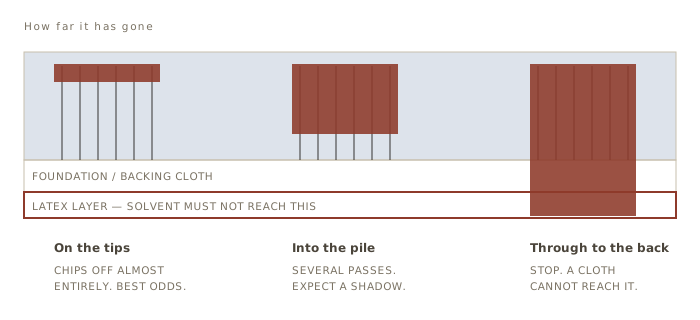
Liquid polish is mobile. Every minute it sits, more of it wicks down the pile toward the foundation, and once it reaches the base of the pile no cloth can reach it. So the volume that is still standing on the surface should come off now, with a blunt edge and a dry cloth.
What is left in the pile is a different problem. Applying solvent to wet polish can make it more mobile and carry pigment farther into the pile. Let that residue harden instead. A cured film is brittle, it sits mostly on the upper pile, and it can be chipped away as solid fragments — which removes pigment bodily rather than washing it deeper.
Why this runs against most advice
The University of Georgia recommends treating carpet stains promptly and using a solvent after removing the excess. Letting the remaining film harden before trying a small solvent pass is our conservative approach for a removable rug: it may allow more lacquer to lift as fragments. It has not been validated in a controlled comparison, so stop if the rug is valuable or the polish has soaked deep into the pile.
Three checks first
All three take under a minute. Each can change the method entirely, and the third is the one everybody skips.
First check — what is the pile made of
Look for the label sewn to a corner of the back; US labeling rules require it to name fiber content by generic name and percentage. If there is no label, the fiber you most need to rule out is viscose, which is sold as art silk, bamboo silk, banana silk, faux silk and rayon.
The practitioner's tell for viscose is that it looks more expensive than it was. It carries a hard, almost metallic sheen that flips sharply as you change viewing angle, it feels cool and slightly slick rather than springy, and the pile lies flat and shows footprints readily. Wool compresses and recovers, and feels warm and faintly greasy from its lanolin. If you need certainty, the burn test in silk rugs settles it in a minute.
Second check — what is on the back
Turn a corner over. If the pattern reads through to the reverse, the rug is woven or knotted and has no adhesive layer to lose. If a separate cloth backing is glued over the construction, it is hand-tufted, and a layer of latex sits between the pile and that cloth.
The Carpet and Rug Institute's own spot-removal guidance is explicit that solvent must never be poured onto a textile floor covering or allowed to reach the backing, because it can damage the latex bonding the primary and secondary backings together. University extension guidance puts it more bluntly: solvents can destroy carpet backing. A tufted rug whose latex bond has been softened does not fail on the day — it delaminates months later, by which point nobody connects the two events.
Third check — does the rug's own color move
Put a few drops of whichever remover you intend to use on a white cloth, press it against a hidden area — the underside of an edge, or a corner that lives under furniture — and hold for thirty seconds. Then look at the cloth, not at the rug.
Any color on the cloth means the rug's dye is mobile in that solvent. Stop there. Every source consulted for this guide agrees on this step, from trade bodies to national cleaning franchises, and it is the single cheapest piece of insurance available.
The sequence
- Lift the standing polish. A spoon edge, a butter knife or a credit card, working from the outer edge of the spill inward so you are pushing polish toward the middle rather than widening it. Wipe the tool on a paper towel between passes.
- Blot straight down. Press a dry white cloth onto the spill with your palm; do not drag it. Lift, fold to a clean face, press again. White cloth matters twice — it shows what is transferring, and it cannot give its own dye back to the rug.
- Stop, and let the remainder harden. Wait until it is fully dry to the touch; the time varies with the thickness of the spill. Put a towel underneath if the rug is on a hard floor, in case anything has gone through.
- Chip the cured film away. Work a blunt edge under it and lift it off in pieces rather than scraping it flat. An art-gum eraser may help with a small hardened residue, but stop if it abrades the pile.
- Vacuum every fragment. Any flake left in the pile is polish waiting to be redissolved into a wider stain by the next step.
- Test, then apply solvent to the cloth. Never to the rug. A few drops on a folded white cloth, damp rather than wet.
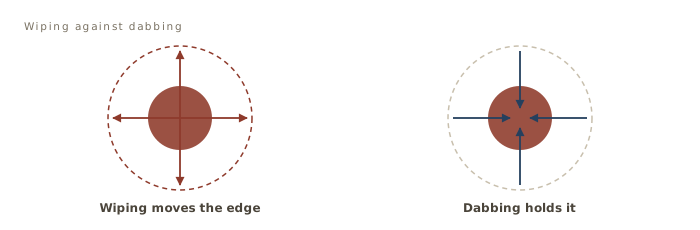
- Dab inward from the edge. Short vertical presses, not circles and not strokes, refolding to a clean section every few presses. The moment you find yourself rubbing, stop — rubbing frays the pile and leaves a fuzzy patch that outlasts the stain.
- Rinse cold. Damp cloth, cool plain water, same blotting motion. Solvent residue keeps working on whatever it sits against, and any detergent residue attracts soil and leaves a dull halo around the cleaned area.
- Dry fast, both faces. Press with a dry towel, stand on it, then put a fan on it. Drying both faces promptly helps avoid watermarks and prolonged dampness.
Stop if rug color appears on the cloth
The solvent is stripping dye, and continuing produces a bleached patch that is permanent and far more visible than the polish was. A partly removed stain beats a color-loss patch every time. This is one of the few spills where stopping early is not a compromise — it is the correct answer.
Film, pigment and what solvent reaches
Polish colors a rug with pigment, not dye — and that distinction is the reason mechanical removal beats chemical removal here.
Formulations vary, but many use nitrocellulose as a film former, with plasticizers, resins, pigments and volatile solvents such as ethyl or butyl acetate. When polish dries, the solvents flash off and leave a tough waterproof film with the pigment locked inside it.
A dye dissolves and bonds chemically to the fiber. A pigment does not — it sits as discrete particles held in place by the film around them. Break up and remove the film and pigment may leave with it physically. That is the reasoning behind trying gentle mechanical removal before solvent.
What remains after the film is gone is loose pigment trapped between fibers, plus, in some polishes, a small quantity of genuinely soluble dye. More solvent may not remove that shadow and can instead lift the rug's own dye. Stop if the cloth begins picking up the rug's color.
Solvent by fiber
Acetone destroys acetate, triacetate and modacrylic on contact. It does not dissolve nylon, polyester, polypropylene, wool, cotton or jute. This is the point the category gets backwards, and it is worth stating before the table.
Acetone is a solvent for particular plastics. Acetate and triacetate are cellulose esters — chemically the same family as the nitrocellulose in the polish, which is precisely why acetone takes them apart. Modacrylic behaves similarly. None of the three is common in modern rug pile, but modacrylic appears in faux-fur and novelty rugs and acetate turns up in inexpensive decorative pieces.
The fibers that make up the overwhelming majority of synthetic rugs — nylon, polyester and polypropylene — are not meaningfully attacked by acetone. Neither is cellulose: cotton, jute and sisal do not dissolve in it. Wool and silk are protein fibers and do not dissolve in it either. What acetone does to wool, silk and any dyed fiber is a question about color, not structure.
| Pile fiber | Acetone | Acetone-free | What actually decides it |
|---|---|---|---|
| Nylon | After a test | Yes | Structurally unaffected. The risk is the rug's dye, not the fiber. |
| Polyester | After a test | Yes | Generally unaffected; some sources report distortion of very fine filaments. |
| Polypropylene | After a test | Yes | Usually solution-dyed, so its color is unusually stable against solvent. |
| Wool | Prefer not to | With caution | Does not dissolve, but dulls the fiber surface and lifts acid dyes. Detergent route first. |
| Cotton | With caution | Yes | Cellulose is safe from acetone; cotton rug dyes are often the least stable in the room. |
| Jute, sisal, seagrass | Dry method only | Dry method only | The solvent is not the danger. The moisture is — these watermark as they dry. |
| Viscose, art silk | No | No | Marked by solvent and by clean water alike. No home method exists. |
| Silk | No | No | Solvent-sensitive protein fiber, easily watermarked. Professional only. |
| Acetate, triacetate | Never | No | Acetone can dissolve these fibers. Extension guidance names them explicitly. |
| Modacrylic | Never | No | Softens, distorts or dissolves. Common in faux-fur and novelty rugs. |
| Tufted construction | Sparingly | Sparingly | Whatever the pile is, solvent reaching the latex softens the bond holding the rug together. |
Buy the clear kind
Colored and conditioning removers carry dyes and oils of their own. Extension stain-removal guidance is consistent on this: use a non-oily remover, never an oil-type one. An oily remover leaves a residue that attracts soil, so you trade a colored mark for a gray one that grows. Many acetone-free removers are ethyl acetate based. Their ingredients vary, so check the label and test the exact product before use; a slower solvent may require more gentle passes. Isopropyl alcohol is gentler still and worth a pass before anything stronger.
Wool, which is its own case
Wool is a protein fiber often colored with acid dyes, and both facts constrain what may touch it. Strong alkalis, oxidizers and enzyme cleaners can harm wool or its color. WoolSafe tests cleaning products for use on wool and urges caution with peroxide; its published research does not support a blanket 1% limit. Avoid improvised ammonia, peroxide or bleach mixtures on a wool rug.
For polish on wool, that means starting with a quarter-teaspoon of clear dishwashing detergent in a cup of cool water, worked with a cloth rather than a brush, and accepting that it will take more passes than a solvent would. Keep the water cool. If detergent stalls and you decide to try an acetone-free remover, test first and use only a few light passes before reassessing.
Viscose has no home method
This is the most consequential paragraph on the page. Viscose and the various silk names it is sold under are damaged by solvent and by plain water — water alone produces a browning discoloration that professional cleaners describe as only partly and inconsistently reversible. There is no version of this repair you can do with a cloth. Blot up standing polish with a dry cloth to stop it spreading, put nothing wet on it at all, and call a cleaner who says without hedging that they handle the fiber.
What the published advice gets wrong
We reviewed the guidance currently ranking for this problem: a carpet trade body, a university extension service, two national cleaning companies, a home-services marketplace, a washable-rug brand and a specialist cleaner. On the central question — may acetone go on a rug — they disagree, and several are wrong for the same reason.
| Source type | Position on acetone | Our read |
|---|---|---|
| Carpet trade body | An ordinary dry-cleaning solvent subject to standard precautions; never let it reach the backing | The most accurate position found. A handling rule rather than a verdict. |
| University extension | Non-oily remover permitted except on acetate, triacetate and modacrylic; pretest for colorfastness | Correct, specific, and the only source that names the actually prohibited fibers. |
| National cleaning franchise | Does not recommend acetone on carpet; also recommends 10–15 pumps of hairspray | Over-broad, and the hairspray step contradicts the caution preceding it. |
| Home-services marketplace | Nail polish remover “can dissolve synthetic fibers”; use rubbing alcohol or hairspray | Wrong as written. Nylon, polyester and olefin are not dissolved by acetone. |
| Washable-rug brand | Acetone-free is gentler; acetone works better on synthetics | Broadly right, and the most usable rule among the commercial sources. |
| National cleaning company | Acetone removes dyes and damages fibers; use dish soap | Half right. Dye loss is the real risk; fiber damage applies only to three fibers nobody names. |
| Specialist cleaner | More acetone will not shift the residual color; it only pulls the rug's own | The most useful observation found anywhere, and it appears in exactly one place. |
The recurring error
“Nail polish remover dissolves synthetic fibers” is the most repeated claim in this category and it is the wrong way round. The fibers acetone destroys are semi-synthetic cellulose esters and a specialty acrylic, none of them mainstream rug pile. The fibers people actually have underfoot are nylon, polyester and polypropylene, and acetone does not dissolve any of them. A reader who follows the general warning avoids the solvent that would have worked and never learns the name of the one fiber in the house that acetone genuinely would have ruined.
On hairspray
Hairspray appears in most consumer guides to this stain, usually with a pump count. Whatever effect it has comes from its alcohol content, which is a weaker solvent than either acetone or ethyl acetate. It also deposits the polymers that make hair hold shape, which are film-forming resins in the same broad class as the nitrocellulose you are trying to remove. Alcohol concentration varies by formulation and is not declared on the can.
We have found no testing establishing how well it works or what it leaves behind, so we are not going to tell you it fails. We will say that it amounts to applying an undisclosed quantity of a weak solvent along with a resin, when a bottle of clear acetone-free remover costs very little and its active ingredient is known. If you want the milder option, that is what the milder option looks like.
When to stop and call someone
Five situations, where further home treatment can make the damage worse.
- The rug is viscose, art silk or silk. Neither solvent nor water is safe. Blot standing polish dry and stop.
- The rug is hand-knotted, antique or valuable. A failed home treatment can leave a color-loss patch that needs specialist repair.
- The polish has soaked through to the backing. Blotting cannot reach it and solvent should not.
- The rug's color came off on the test cloth. Fugitive dye needs stabilizing before anything wet touches the rug.
- The film is gone and a colored shadow remains. This is the right moment to hand over, and the moment at which most people instead keep going and cause the damage the professional then has to correct first.
A professional has more selective solvents than anything sold retail, plus the option of dye correction afterwards — see DIY against professional. Ask whether they wash in-plant rather than on site, whether they run a dye-stability test before treatment, and, for viscose, whether they handle that fiber specifically. Hesitation on the third question tells you something useful.
What we could not verify
The harden-first sequence is our cautious interpretation for removable rugs; the University of Georgia’s carpet guidance instead recommends prompt solvent treatment after blotting or scraping. We found no controlled comparison establishing which sequence works better by fiber, polish formula and spill depth. We also found no reliable success rate for either method or a measured pass count for acetone-free remover. If the residue is deep, the rug is valuable, or dye transfers on a test cloth, stop and consult a specialist.
Common questions
How do you get nail polish out of a rug?
Blot away the liquid with a dry white cloth working from the outside in, then let the remainder harden rather than attacking it wet. Chip the cured film off with a blunt edge and vacuum the fragments. Only then apply a clear, non-oily remover to a cloth — never to the rug — and dab inward from the edge of the stain. Rinse cold, blot, and dry with air on both faces.
Should you let nail polish dry before treating it?
Partly. Remove the standing liquid immediately, because every minute it sits it wicks further down the pile. But do not put solvent on wet polish: that redissolves it into something thinner and more mobile that can spread farther into the pile. Let the residue set, then lift the brittle film mechanically.
Does nail polish remover ruin carpet?
Not usually, and the risk is not the one most guides describe. Acetone does not dissolve nylon, polyester or polypropylene, which is what most carpet and most synthetic rugs are made of. It does dissolve acetate, triacetate and modacrylic on contact. The commoner problem on any fiber is that acetone lifts the carpet's own dye, leaving a pale ring beside the stain.
Can you use acetone on a wool rug?
Prefer not to. Acetone will not dissolve wool, but it dulls the fiber surface and lifts the acid dyes wool is colored with. Start with a quarter-teaspoon of clear dishwashing detergent in a cup of cool water and expect more passes. Avoid improvised ammonia, bleach, peroxide and enzyme treatments on wool.
Does hairspray work on nail polish?
Any effect comes from its alcohol content, a weaker solvent than nail polish remover, and hairspray also deposits the film-forming resins that make hair hold. Alcohol concentration is not declared and varies by product. If you want something gentler than acetone, clear acetone-free remover is the option whose active ingredient you actually know.
Is acetone-free remover safer?
Milder and slower. Acetone-free removers are generally ethyl acetate based, a weaker solvent than acetone, so expect that it may take longer. That is the right trade on wool, on cotton, and on any rug you are nervous about. Buy the clear version — colored removers and those with added oils introduce residue of their own.
The polish is gone but a colored shadow remains. Now what?
Stop applying solvent. What is left is pigment particles trapped between the fibers after the film around them has been removed, and solvent has very little purchase on it. Continuing acts mainly on the rug's own dye and blends the two into a pale patch. This is the point to hand it to someone with selective solvents and the ability to correct color afterwards.
Can you use a carpet cleaning machine on it?
Not for this. A machine floods the area, which drives polish downward into the foundation and, on a tufted rug, soaks the latex layer. It also cannot deliver solvent to a single square inch, which is the whole technique here.
Should you use hot water?
No. Keep everything cool. Heat can set the stain, and on wool it mobilizes dye and accelerates alkaline damage at once. Cool water for rinsing, and a fan rather than a hairdryer for drying.