
"Antique" has a working definition — a hundred years or more — and a great deal of stock described that way does not meet it.
Dating from the object
There is no universal registry. Documents can help when provenance is reliable, but dating usually also requires examining the rug. These four observations raise useful questions; none dates a rug by itself.
Yarn. Hand-spun wool varies in thickness along its length; machine-spun does not. Even yarn may suggest machine spinning, but cannot establish a century on its own.
Dyes. Both natural and synthetic dyes appear in old rugs. Colour change, bleeding and abrash can provide clues, but a visual inspection alone cannot prove a dye's chemistry or the rug's age — see rug colors.
Wear pattern. Real age produces wear that follows use: heavier at traffic lines and ends, lighter where furniture stood, foundation showing first at points of pressure. Artificial distressing can mimic some wear, so look for consistency across the whole rug.
Finishing. Repairs can reveal use and restoration history. Ask which ends and edges are original and which have been worked on — rug repair.
Distressing is an industry
Chemical washing, sun-fading, pile shaving and tea or walnut staining are routine commercial treatments used to produce an aged appearance on new rugs. They are not illegal, not always undisclosed, and they are done well.
Where the value still is
There is no dependable price trend for all antique rugs. Condition and design can matter more than age, and the right comparison is a recent sale for similar material with similar wear. Our rug value guide explains how to make that comparison.
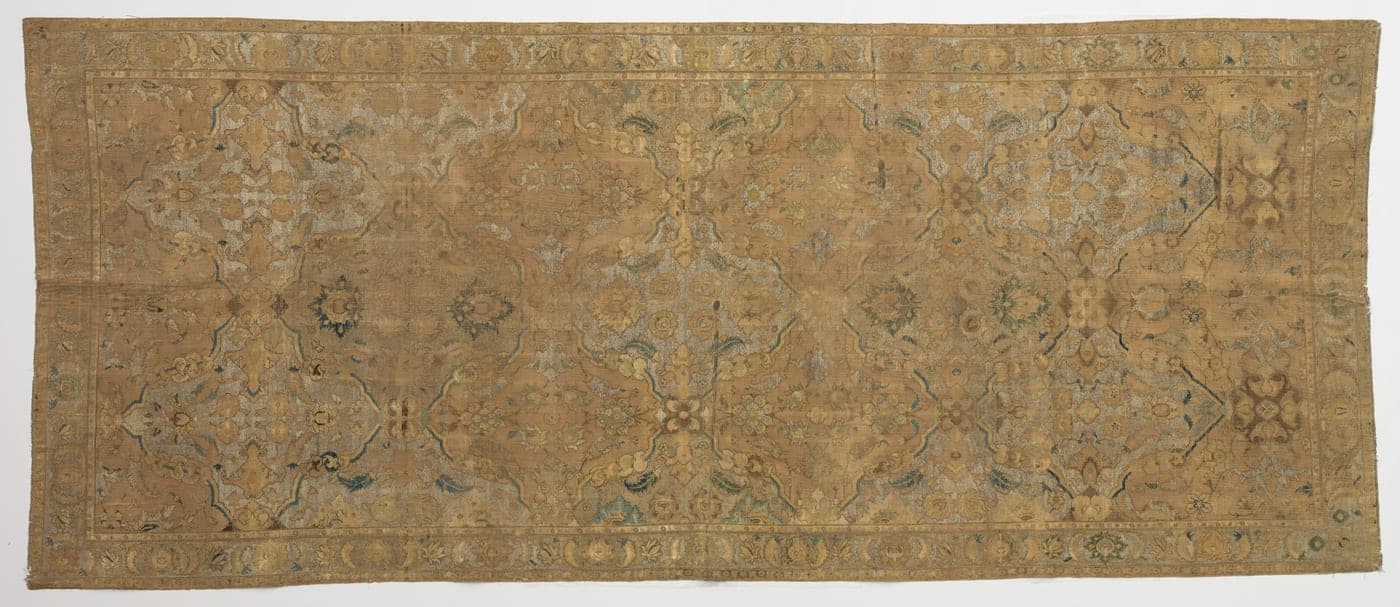
This is a Persian carpet, and for most of a century it was catalogued as Polish. A set of them appeared at the 1878 Paris exhibition bearing Polish coats of arms — added by their European owners — and the attribution stuck so firmly that the trade still calls them Polonaise. Provenance is the most repeated and least verified claim in this business, and it fooled the museums first.
senna knot: silk, silver and gold filé brocading
Cleveland Museum of Art, 1942.25 · Gift of Grace Rainey Rogers in memory of her father, William J. Rainey · CC0
In its favour
- Natural dyes and hand-spun wool, which no amount of money buys in new production
- Softer, more complex colour that photographs badly and looks superb in a room
- A documented older rug may have a clearer comparison set than an unidentified one
- Genuine scarcity in traditions where weaving has stopped
Against it
- Condition risk is real and expensive to assess properly
- Restoration can exceed the value of a middling example
- Attribution is harder and more contested the older the rug
- Age and origin claims may be difficult to verify
If you are comparing Qashqai, Baluch, Afghan or Caucasian rugs, compare within the same tradition. Knot density by itself does not explain condition, quality or price.
What to inspect
Everything in identification, plus two things specific to age.
Raking light from a low angle. Reweaving and repiling show as differences in sheen and pile direction that are invisible face-on. On an antique of any value, assume restoration has happened and find it.
Foundation brittleness. Ask a specialist to examine a brittle or weakened foundation; forcing a fold can make damage worse. Repair cost must be weighed against the rug's value.
Buying
Get the age claim written on the invoice with the basis for it. "Circa 1900" in writing is a representation you have recourse on; the same words spoken are not.
For anything above a few thousand, commission an independent appraisal before purchase from someone with no interest in the sale — rug value and appraisal.
For the adjacent and looser category, see vintage rugs; for establishing what a rug is at all, rug authentication.
For the context behind age claims, read the history of Persian rugs and the Safavid workshop period. A familiar historic pattern is not evidence that the rug itself is old.
If you are shopping rather than identifying a rug you own, use what to look for in an antique rug for the condition check and where to buy antique rugs to compare the information a dealer, auction house and private seller can provide. A claimed antique Persian rug needs both an age assessment and an origin assessment.
How to estimate a rug's age sets out the limits of dye, wear and provenance evidence when a seller gives a precise year.
Everything on antique rugs
The 4 areas this subject divides into, and the guides beneath each.
- Where to Buy: Antique Rugs — Specialist dealers, auction houses and estate sales — where genuine antique material actually trades, and why the general rug trade is the wrong place to look.
- Antique Rugs: What to Look For — The inspection specific to age — dating from yarn, dye and wear, finding restoration under raking light, and assessing a foundation that may be a century old.
- Antique Rugs: Red Flags — Manufactured age, undisclosed restoration and the specific misrepresentations that concentrate in this category — where the money makes them worthwhile.
- Antique Rugs on a Budget — Where genuine nineteenth-century material is still affordable — the traditions, formats and conditions the market currently undervalues.
Every guide in Antique
All 4 articles in this section, starting with the ones we would hand someone new to it.
- Antique Rugs on a Budget — start here
- Antique Rugs: Red Flags — start here
- Antique Rugs: What to Look For — start here
- Where to Buy: Antique Rugs
Common questions
What counts as an antique rug?
A hundred years or more, which in 2026 means woven before 1926. "Semi-antique" has no agreed definition and is used loosely for roughly 50 to 100 years old — because it means nothing specific, treat it as a marketing term rather than information.
Are antique rugs always worth more?
No. Condition, design, size, origin and comparable sales all matter. A younger rug in sound condition can be worth more than an older one with serious structural wear.