
The Caucasus produced the most graphically confident weaving in the classical rug world, and then largely stopped. That combination — exceptional design, finite supply — is why the antique market treats it seriously.
The regions
- Kazak
- South-west; huge bold medallions, long lustrous pile
- Shirvan
- East; finer, denser, small repeating motifs
- Kuba
- North-east; intricate, often ivory ground, precise drawing
- Karabagh
- South; French-influenced florals alongside geometry
- Talish
- Long narrow formats, plain field, distinctive borders
- Daghestan
- Prayer formats, lattice fields, fine weave
The distinguishing move is scale. Where Persian city weaving fills a field with fine repeating detail, Caucasian weaving tends to place a small number of very large forms against an open ground and let them carry the whole rug. That is why these rugs read as modern — the graphic logic is closer to twentieth-century abstraction than to classical carpet design.
Why supply is closed
Village and tribal weaving in the Caucasus was effectively ended by Soviet collectivisation from the 1920s. Production continued under state workshops, but the combination of hand-spun wool, natural dye and locally transmitted design did not survive it.
The practical consequence: a genuine pre-1920s Caucasian rug is a finite object. Later Soviet-era production exists, is honest enough, and is worth a fraction.
Dye
Caucasian weaving has the strongest reputation for natural dye of any regional tradition, and it is deserved. Madder reds that age towards brick rather than brown, indigo blues with visible vat variation, and a yellow-over-indigo green that fades unevenly as the yellow gives out first.
Abrash — horizontal banding where a new dye lot began — is normal, expected, and part of what collectors pay for. How dyes behave over time is covered in rug colors.
What to check on an expensive one
Reweaving. At these prices restoration is economic, so assume it has happened and find it. Look under raking light from a low angle — repiled areas differ in sheen and pile direction in a way that is invisible face-on. The full sequence is in identification.
Format
Most Caucasian weaving is small. Village looms were narrow, so room-size Caucasian carpets are uncommon and priced accordingly; the standard formats are roughly 3×5 to 5×8, plus long narrow runners from the Talish and Karabagh regions.
If you want a large antique rug, this is not the tradition — look to Persian village weaving such as Heriz instead. If you want one outstanding graphic object for a wall or a small room, it is exactly the tradition.
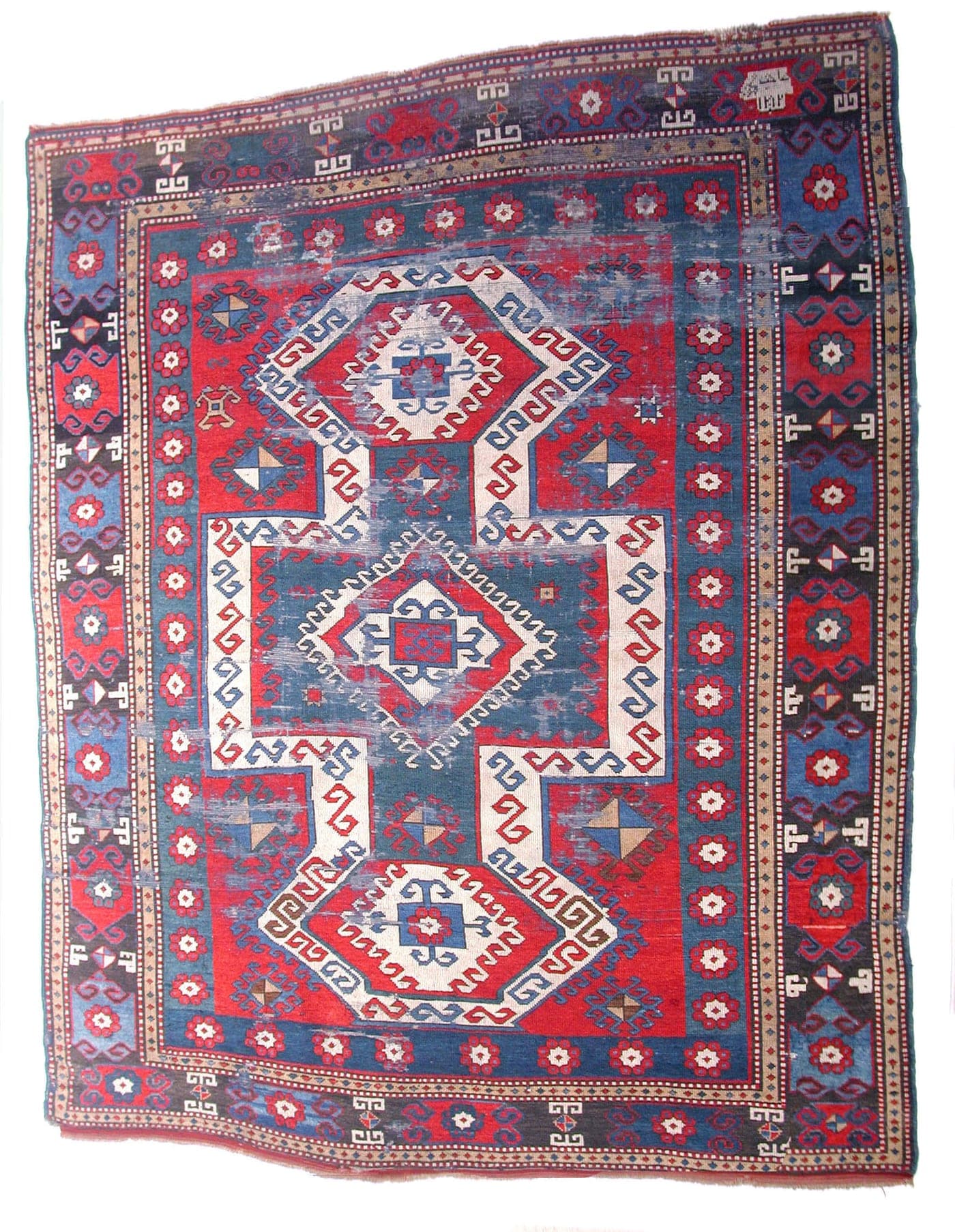
Kazak weaving, and the rug carries its own date — 1212 AH, which is 1797. A rug inscribed with its date is unusual and useful: it fixes a point that dye analysis and wear pattern can only bracket.
Wool (warp, weft, and pile); symmetrically woven pile
The Metropolitan Museum of Art, 1971.263.8 · Gift of Joseph V. McMullan, 1971 · Public Domain (CC0)
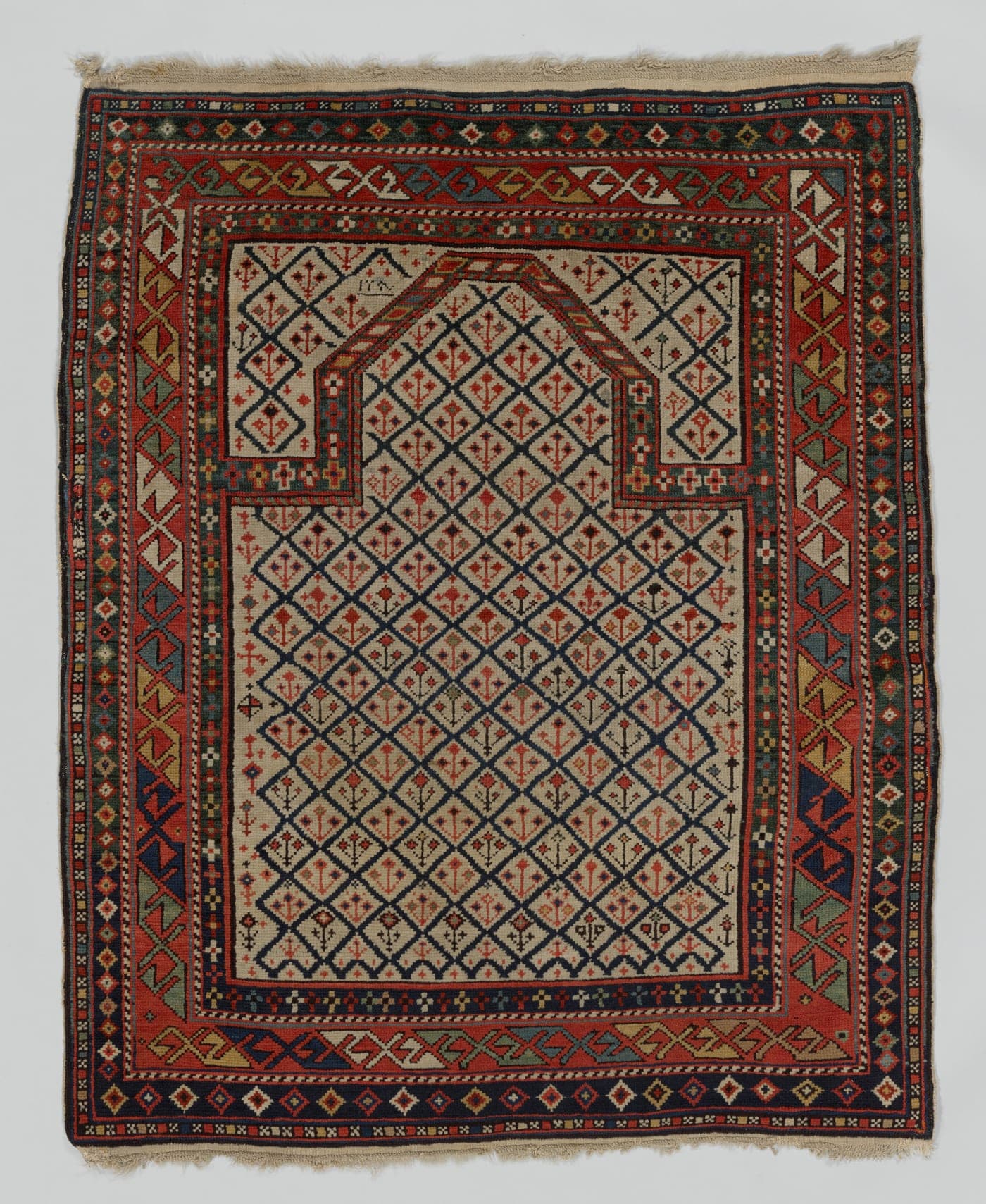
The mihrab — the arch — is the prayer format, and it orients the rug in use. The lattice of individually coloured flowerheads is a Daghestan signature, and it is also a good place to look for abrash, since each small block came from whatever batch was to hand.
wool and linen; ghiordes knot, extended tabby, fringe
Cleveland Museum of Art, 1945.166 · Gift of Mrs. John H. Walsh · CC0
Buying
This is a collector category, which means the gap between a good example and a mediocre one is wide and mostly invisible to a beginner. Two habits protect you: buy from someone who will put the attribution and the restoration history in writing, and get an independent appraisal before committing at any serious level — see rug value and appraisal and antique rugs.
Auction is where this material genuinely trades. Retail asking prices in this category diverge from realised prices more than in most.
Common questions
Why are antique Caucasian rugs expensive?
Supply. Serious weaving in the region largely ended with Soviet collectivisation in the 1920s and 30s, so the antique market is closed — no more are being made. Add exceptional natural dye, strong graphic design that suits modern interiors, and a dedicated collector base, and prices for good examples are high.
What is a Kazak rug?
Weaving from the south-western Caucasus, characterised by large-scale bold geometric medallions on a saturated red or ivory ground, a long lustrous pile and a coarse symmetrical knot. The name refers to the region, not to Kazakhstan or to Cossacks.