
India has the longest continuous carpet industry outside Iran and the largest by volume today. It is also the country whose output is most often sold as something else.
The Mughal inheritance
Carpet weaving arrived in India under Akbar in the sixteenth century, brought from Persia along with the weavers. What followed was not imitation: Mughal court carpets developed a distinct naturalism — recognisable plants, individual flowering specimens, animals drawn from observation — that has no real parallel in Persian weaving of the period.
The best Mughal pieces are among the finest carpets ever made, woven on silk foundations at densities above 1,000 knots per square inch. They are museum objects.
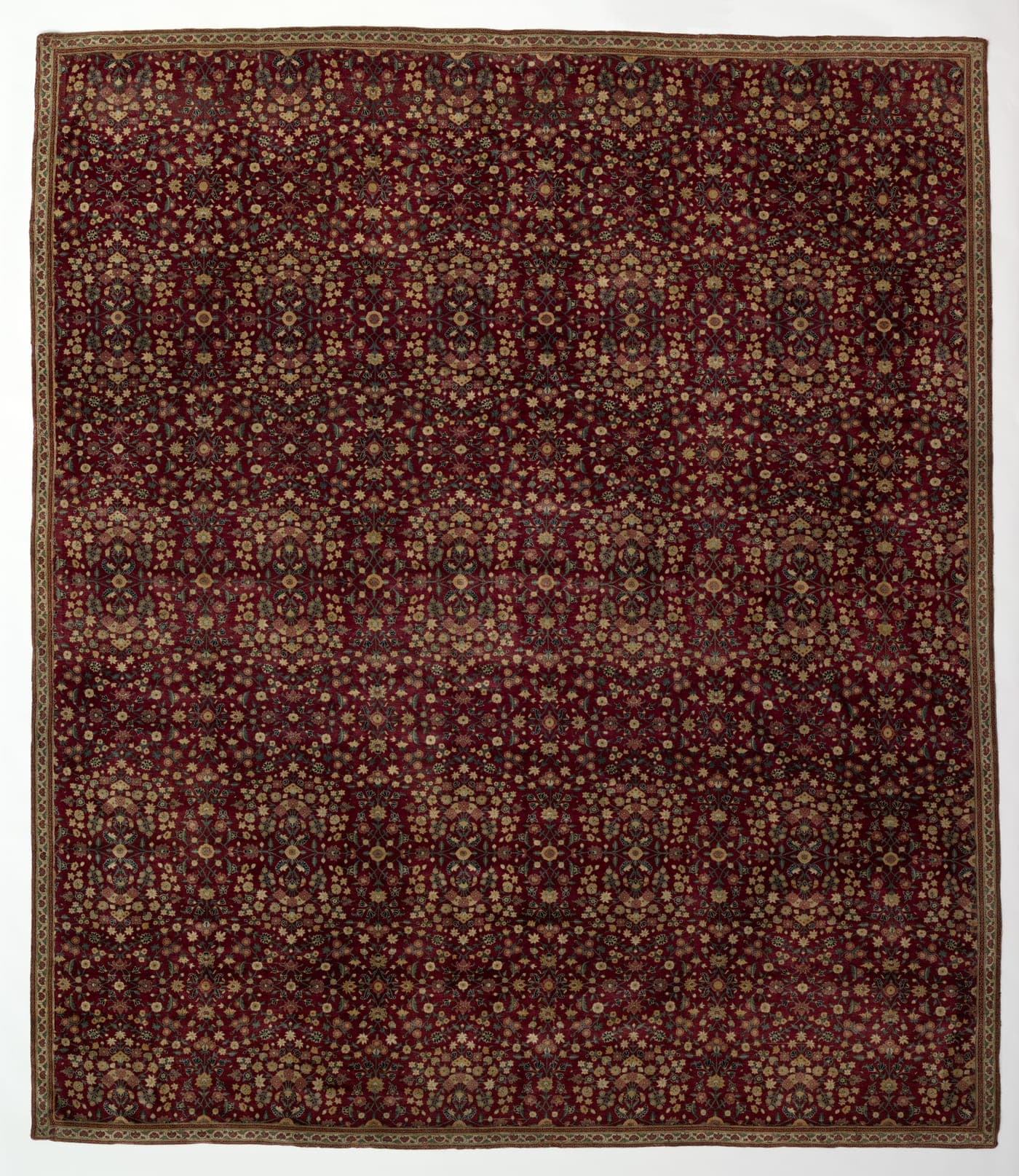
Millefleurs — a thousand flowers — woven in Kashmir in pashmina, with an asymmetric knot. This is the naturalism the Mughal workshops added: the plants are individual specimens observed from life, not a motif stamped across a field. It is the clearest single argument against reading Indian weaving as Persian imitation.
Pashmina (wool): asymmetrical knot
Cleveland Museum of Art, 1936.17 · Dudley P. Allen Fund · CC0
The design vocabulary survived into Agra and Amritsar production in the nineteenth century, which is what most "antique Indian" in the trade actually refers to. Antique Agras in room sizes are genuinely good decorative carpets and reasonably valued.
Modern production
- Bhadohi–Mirzapur
- The largest weaving belt in the world by output
- Jaipur
- Fine hand-knotted and designer collaboration work
- Kashmir
- Silk and fine wool on cotton, Persian drawings
- Panipat
- Flatweave, hand-tufted and machine production at volume
India is where most of the world's contemporary hand-knotted rugs are actually made, including a great deal of what is sold under Western designer labels. At the top end the work is excellent — Jaipur workshops produce hand-knotted rugs to a standard that compares with anything currently woven anywhere.
At the volume end, India also produces enormous quantities of hand-tufted rugs, which is where most of the market's confusion originates.
Where to be careful
Attribution. A rug woven in Bhadohi to a Tabriz drawing is an Indian rug. It may be very good. It is not a Persian rug, and the difference is usually a factor of two or three in price. The construction tests in identification settle it independently of the label.
Construction. India is the largest producer of hand-tufted rugs, and they are frequently sold in ways that let a buyer assume hand-knotted. Turn the rug over: a scrim glued to the back means tufted. See hand-knotted rugs.
Viscose. Marketed as art silk, bamboo silk or banana silk, and used heavily in Indian commercial production. It looks superb in a showroom and degrades badly in use — see viscose rugs.
What Indian production does genuinely well
Custom work. Lead times, minimums and colour matching are more accommodating than almost anywhere else, which is why the designer trade runs through Jaipur. If you want a specific size, palette and drawing, this is where it gets made — see custom rugs.
Buying
Judge the rug rather than the country. Knot density within a comparable type, wool quality by compression and lustre, dye behaviour from tip to base, and finishing at the selvedges and ends. That process is in how to buy Persian rugs and transfers directly.
Get the origin written on the invoice. It costs nothing and turns a verbal claim into something you have recourse on.
Related: pakistani rugs for the neighbouring industry, wool rugs for the fibre, rug prices for what things cost.
Common questions
Are Indian rugs good quality?
They span the full range. India produces some of the finest hand-knotted work in the world alongside enormous volumes of commercial goods, so the country of origin tells you very little. Judge the rug: knot density, wool quality, dye evidence and finishing.
What is the difference between an Indian and a Persian rug?
Design lineage and, usually, price. Much Indian production is woven to Persian drawings, so a rug can look Persian and be Indian. The distinction is checkable from construction and finishing, and it typically represents a substantial price difference for otherwise similar-looking rugs.