
Identifying an unknown rug is a process of narrowing rather than a single test. No one feature settles it; four together usually place a rug within a region.
This page is about determining which tradition a rug belongs to. For placing a rug within Persian weaving specifically — Tabriz against Kashan against Heriz — see Persian rug identification.
Work in this order
- 1. Knot type
- Symmetric or asymmetric. Fold the pile back.
- 2. Foundation
- Cotton warp = city. Wool warp = village or nomadic.
- 3. Palette and dye
- Which colours, and how they have aged
- 4. Format
- Proportions, borders, and what the design does
1. The knot
Fold the rug back along a row of knots — bend it against the pile direction until the base of the pile opens — and look at how the yarn wraps the warps.
Symmetric (Turkish, Ghiordes). The yarn wraps both warps evenly, with the two ends emerging together between them. Robust, slightly less able to render curves.
Asymmetric (Persian, Senneh). The yarn passes fully around one warp and only under the other, so the two ends emerge unevenly. Allows finer curvilinear detail.
A looped knot around a rod, cut afterwards, means Tibetan or Nepalese weaving — a third system entirely.
Broadly: symmetric predominates in Turkish and Caucasian weaving, asymmetric in Persian, Indian, Pakistani and Chinese.
The two rugs below are the contrast, and the museums' own records state the knot in each case — so this is not our attribution.
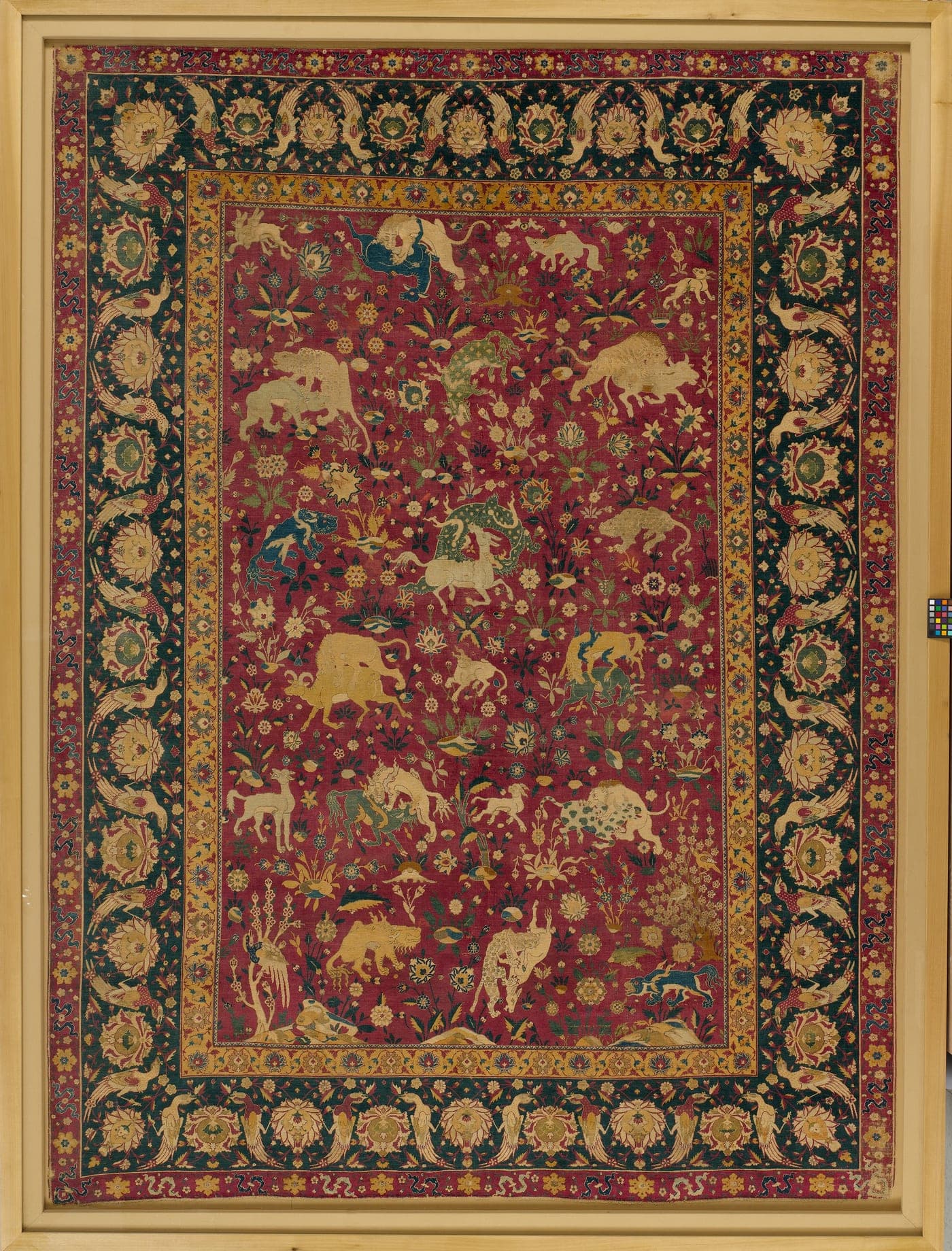
Asymmetric knot. Notice what it permits: continuous curves, animals drawn in the round, vines that bend rather than step. This is a design language that a knot able to render curves makes possible.
Silk (warp, weft, and pile); asymmetrically knotted pile
The Metropolitan Museum of Art, 14.40.721 · Bequest of Benjamin Altman, 1913 · Public Domain (CC0)
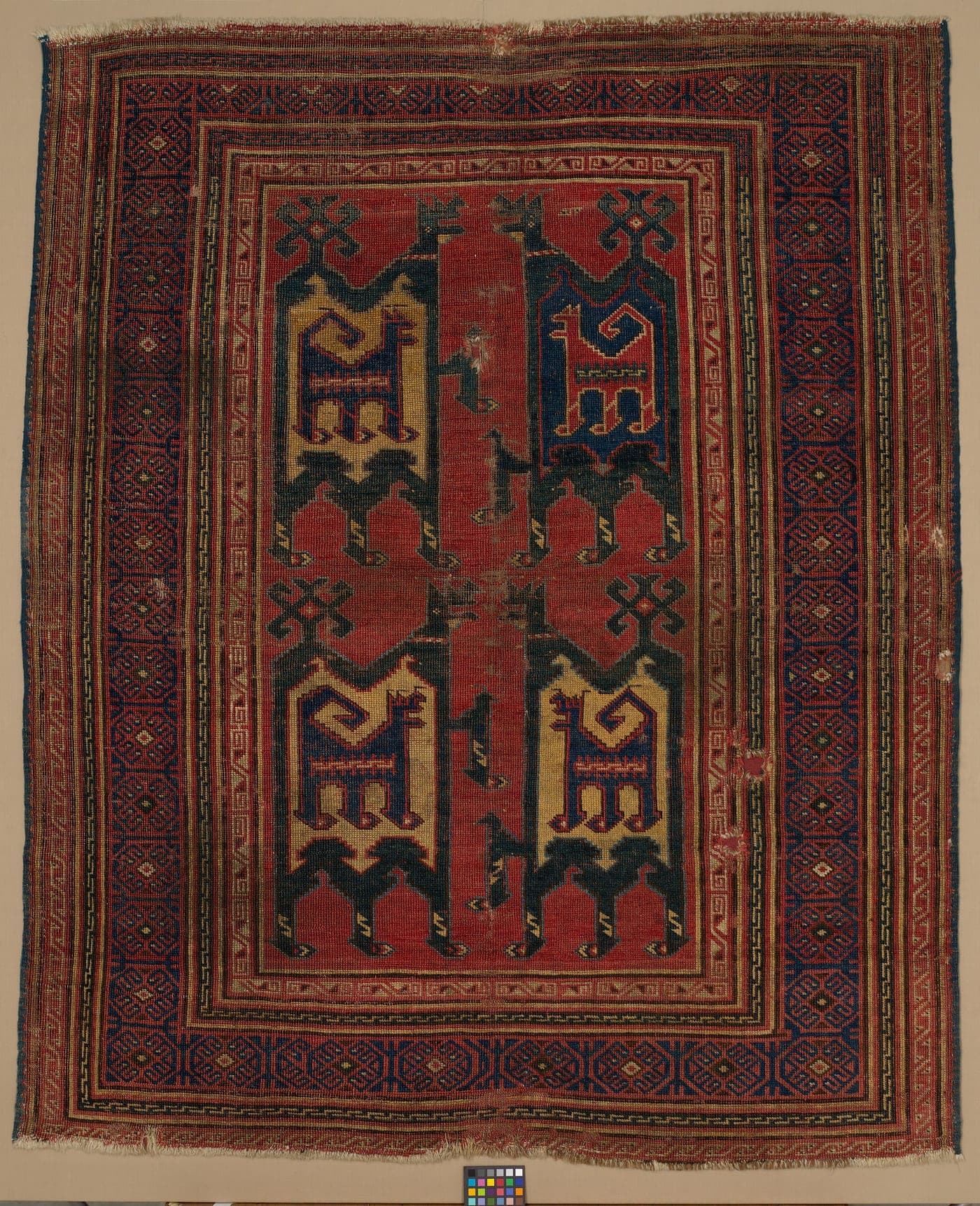
Symmetric knot, and the geometry follows from it. The animals are built from steps and straight runs rather than curves — the same subject as the carpet above, resolved by a different structure.
Wool (warp, weft, and pile); symmetrically knotted pile
The Metropolitan Museum of Art, 1990.61 · Purchase, Harris Brisbane Dick Fund, Joseph Pulitzer Bequest, Louis V. Bell Fund and Fletcher, Pfeiffer and Rogers Funds, 1990 · Public Domain (CC0)
Set side by side, the knot stops being a technicality. It is the constraint that produced two different visual traditions from the same subject matter.
The names are conventions, not borders
Symmetric knots appear in parts of Iran and asymmetric knots in parts of Turkey. Treat the knot as one input of four rather than as a verdict — a rug identified on knot type alone is a guess with a technical vocabulary.
2. The foundation
Look at the warps between the knot rows, and at the fringe, which is the warp on a hand-knotted rug — the anatomy of a rug.
Cotton warp and weft means a workshop rug woven on a fixed vertical loom. Cotton is dimensionally stable and holds tension evenly, which is why city rugs lie flat. This points to urban production: Tabriz, Kashan, Isfahan, and most Indian and Pakistani weaving.
Wool warp means village or nomadic weaving — a portable horizontal loom, and whatever material was to hand. Wool-foundation rugs are more likely to be slightly irregular in shape.
Silk foundation means very fine work, because a thinner warp permits a higher knot count.
Depressed warp — some warps sitting noticeably deeper than others — packs knots more densely and produces a stiffer, heavier rug. It is characteristic of certain centres and is a technique rather than a fault.
3. Palette and dye
Colour is where a rug's age and origin are most readable, and where the most confident nonsense is spoken.
Deep madder red with strong indigo, at large scale — Caucasian village weaving or Heriz.
Red field, indigo spandrels, ivory detail, curvilinear — Persian city weaving.
Almost entirely red, brick to aubergine, repeating guls — Turkmen or Afghan.
Soft apricot, gold, terracotta, low contrast — Turkish Oushak.
Undyed cream with dark line work — Moroccan, and a different tradition entirely.
Ivory ground with restrained blue, very fine — Isfahan or Nain.
Blue, gold and rust with sparse open fields and Buddhist motifs — Chinese, which has a colour logic and symbolism of its own.
Then read the dye behaviour. Bend the pile and compare base to tip: natural dye is usually richer at the base where light never reached. Early synthetic reds from the 1870s fade toward grey or brown rather than to a softer red, and may bleed past a motif's outline — that dates a rug more reliably than any document. Iron-mordanted black corrodes the wool, so black areas of an old rug sit lower than the rest and you can feel it. See rug colors and black rugs.
4. Format and design
A medallion with spandrels and a dense curvilinear field — city workshop, drawn from a cartoon.
Stepped diagonals, repeating geometry, motifs that change size across the field — village or nomadic weaving on a loom without a cartoon. The irregularity is evidence, not a defect.
A prayer arch (mihrab) — Turkish, Caucasian or Persian prayer format.
Long and narrow, far beyond runner proportions — often nomadic, because a portable horizontal loom is narrow.
Repeating guls in columns — Turkmen.
Bands and stripes rather than a field-and-border structure — many tribal and Navajo traditions, the latter being wholly independent of the Oriental group.
Open field with sparse motifs and a wide plain border — Chinese, or contemporary.
For the vocabulary of what you are looking at, see rug patterns and rug motifs.
What identification cannot tell you
Two limits worth stating, because they are where confident identification does damage.
Origin is not quality. A Persian rug can be a coarse, chemically washed, recent commercial piece; an Indian rug can be a 300-knot carpet that outlives its owner. Placing a rug regionally tells you the design language and very little about what it is worth — rug value and appraisal.
Design is copied freely, and always has been. Persian designs are woven competently in India and Pakistan today, Turkish designs in China, and this is normal trade practice rather than fraud. The rug in front of you may be an excellent example of a tradition it did not come from — which is why construction and materials carry more weight than the picture does.
When to get a second opinion
Anything you are about to spend seriously on. Anything described as antique. Anything where the seller's account and what the rug shows do not agree.
An independent appraisal from someone with no interest in the transaction costs a small fraction of a significant rug's price — rug authentication and the rug buying guide.
Common questions
How can you tell where a rug was made?
Work through four things in order: the knot type (symmetric or asymmetric), the foundation material (cotton or wool), the palette and its dyes, and the format and proportions. Each one narrows the field, and together they usually place a rug within a region even when no single clue is decisive.
What is the difference between a Turkish and Persian knot?
The Turkish or symmetric knot wraps around two warps evenly; the Persian or asymmetric knot passes under one of them. The asymmetric knot renders curves better, which is why curvilinear floral designs are predominantly Persian, Indian and Chinese, and bold geometry is predominantly Turkish and Caucasian.
Does the knot type tell you the country?
Not by itself — the names are conventions rather than borders. Symmetric knots appear in parts of Iran and asymmetric knots in parts of Turkey. It is one input among four, and identification comes from the combination rather than from any single test.