
Navajo weaving sits outside the Oriental rug world entirely — different technique, different history, and a legal framework of its own.
The technique
Diné weavers work on an upright loom using a tapestry technique, not knotting. The weft is packed down so hard that the warp disappears completely, producing a flat, extremely dense, reversible textile.
The identifying feature is the edge. The warp is turned continuously at the selvedge rather than being cut, so a genuine Navajo weaving has no fringe. That single check eliminates most imitations, which are usually Mexican or Pakistani copies woven with cut warp ends.
The periods
- Classic (to c. 1868)
- Wearing blankets; indigo, bayeta red, natural wool
- Transitional (1868–1900)
- Aniline dye, Germantown yarn, shift to rugs
- Rug period (1900–1940)
- Trading-post regional styles established
- Revival (1940–present)
- Return to handspun and vegetal dye; contemporary work
The Classic period produced wearing blankets rather than floor rugs, and the chief's blankets of that era are among the most valuable textiles made in North America.
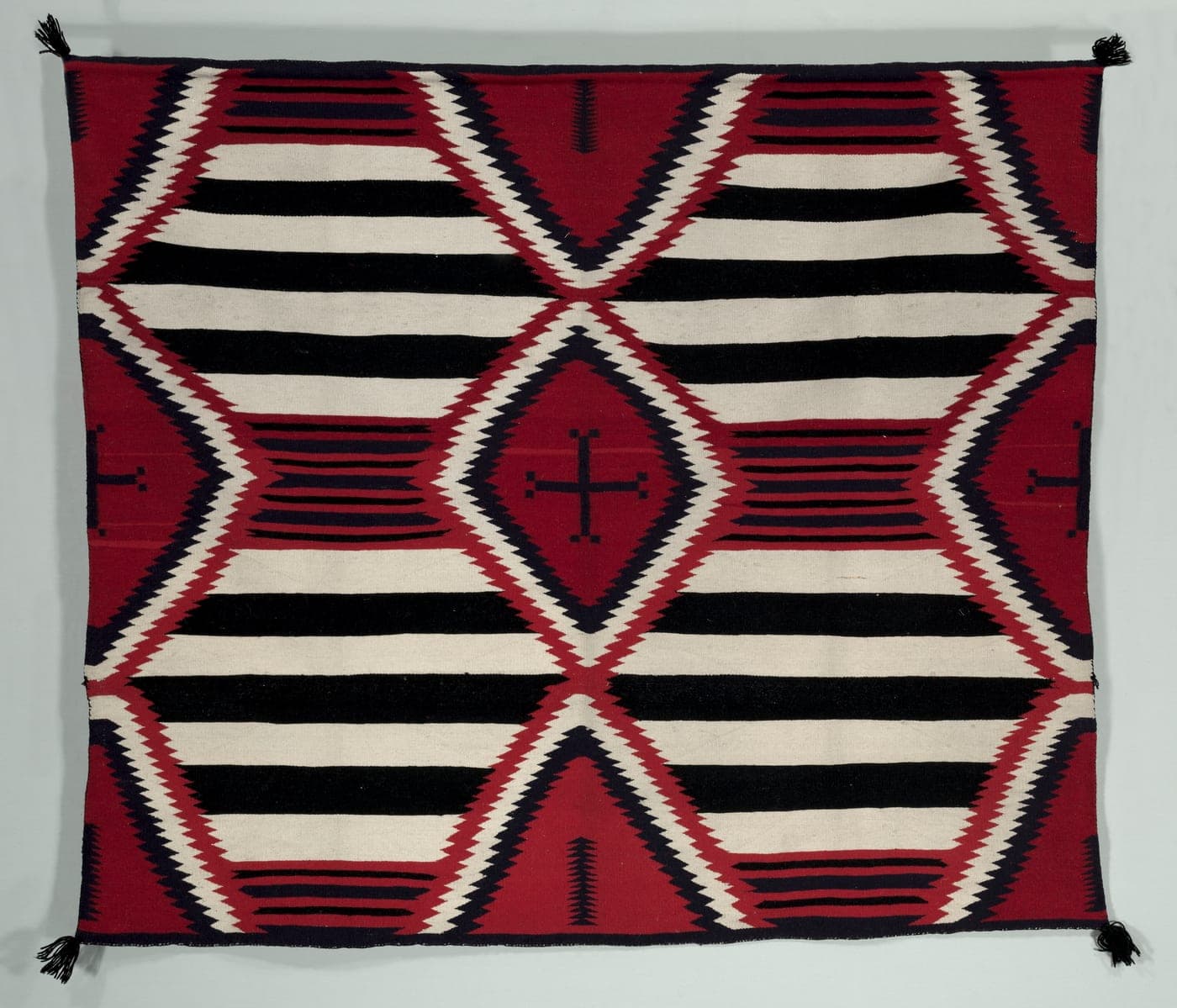
Chief blanket layout, and note what it does not have: no field, no border, no medallion. The composition is horizontal bands, which is what a garment worn across the shoulders needs — and it is the clearest evidence that this is an independent tradition rather than a variant of Oriental weaving.
tapestry weave: wool (handspun, Germantown, and bayeta)
Cleveland Museum of Art, 1937.903 · Gift of Amelia Elizabeth White · CC0
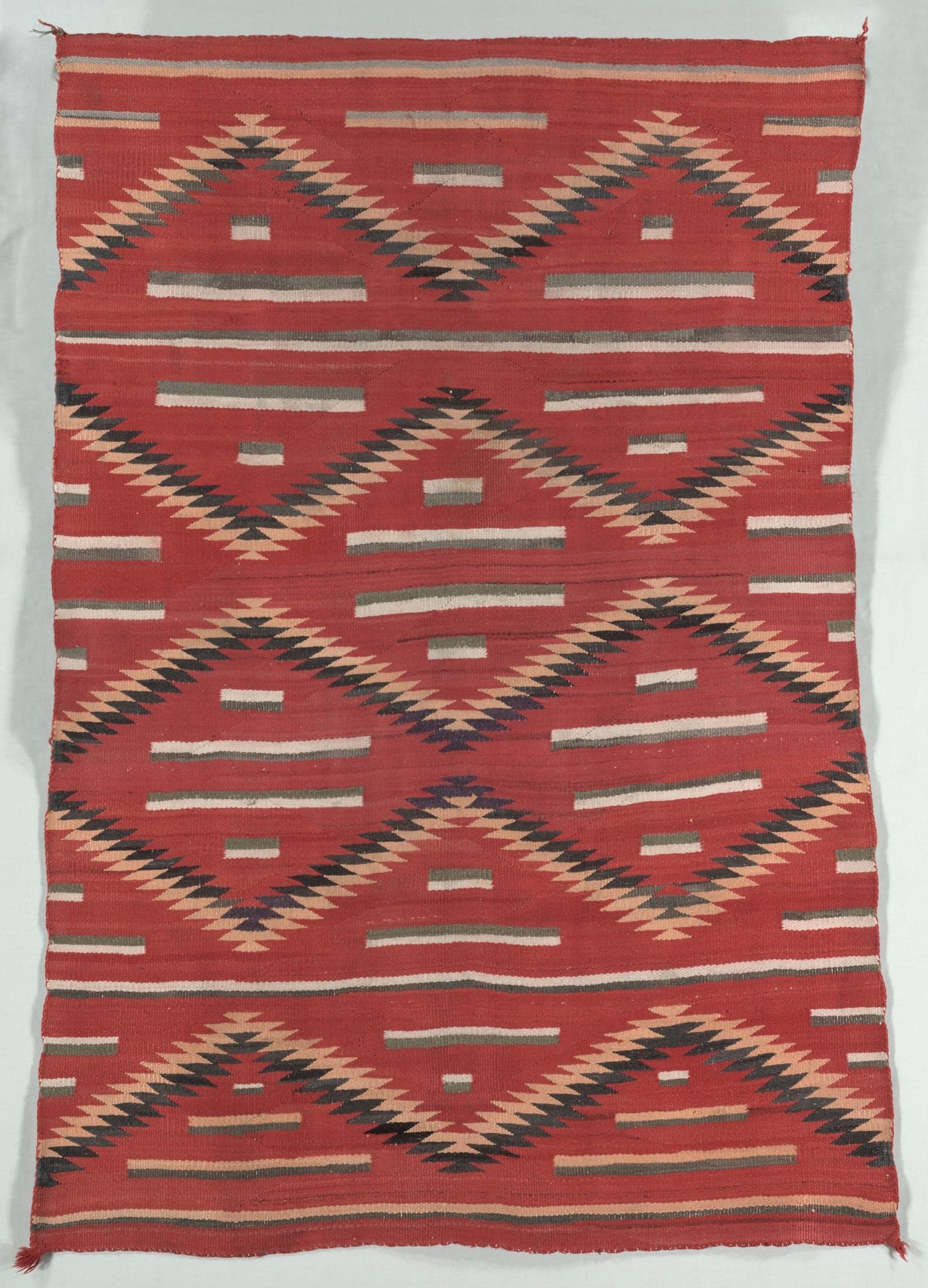
Eyedazzler style, and the aniline dyes are the point. Commercial Germantown yarn in colours no vegetal dye could reach arrived with the railroads, and weavers used them at full saturation. Read as a document, this rug dates itself.
tapestry weave: wool (handspun)
Cleveland Museum of Art, 1937.855 · Gift of Amelia Elizabeth White · CC0
The regional styles most people mean by "Navajo rug" were largely shaped by trading posts around 1900, which encouraged particular palettes and layouts for the Eastern market: Two Grey Hills (undyed brown, grey, black and white, extremely fine), Ganado (deep red ground with black and white), Wide Ruins (banded, vegetal dyes, no black), Teec Nos Pos (busy, outlined, bright), Crystal (banded, soft vegetal).
Buying honestly
This is the category where provenance matters most, both legally and ethically.
Ask for the weaver's name
Contemporary Navajo weaving is signed work by identifiable artists, and a reputable dealer will name the weaver and their community. "Navajo-style" and "Southwest design" are the phrases used when the rug is not Navajo — they are honest descriptions and should be priced as such.
Buy from Diné weavers directly, from tribal enterprises, or from established dealers who document provenance. The weaving economy matters to the communities that sustain it, and the imitation trade takes directly from it.
Value
Driven by weave fineness (wefts per inch), the weaver's reputation, condition, and period. A fine contemporary Two Grey Hills by a known weaver can reach five figures; historic Classic-period blankets go far higher at auction.
Note that the pricing logic is closer to fine art than to the rug trade — the maker's name carries weight in a way it rarely does with Persian or Turkish weaving.
Care
The tapestry structure is dense and flat, with the same practical profile as a kilim: no pile to absorb abrasion, so keep it out of traffic. Many collectors hang them, which is the right answer for anything historic.
Handle wet cleaning as a specialist job — early aniline dyes in Transitional-period pieces are notoriously unstable. See rug cleaning and wool rugs.
Common questions
How can I tell a genuine Navajo rug from an imitation?
Navajo weaving is a tapestry technique with no pile and no fringe — the warp runs continuously and is turned at the selvedge, so there are no loose warp ends. A rug with a fringe is not Navajo. Mexican and Pakistani imitations of Navajo designs are widespread and often fringed.
Is it legal to sell rugs as Navajo?
Only if they are. The US Indian Arts and Crafts Act of 1990 makes it unlawful to offer goods in a way that falsely suggests they are Indian-produced. Misdescription here is not merely bad practice; it is a federal offence.