
"Kilim" is used for any flatwoven rug, and it is properly the name of one specific technique. Four distinct structures get sold under it, and they behave differently underfoot, wear differently, and are worth different money.
All of them share the defining property: no pile. The pattern is made by the weft threads themselves rather than by knots tied into a foundation, which is why a kilim is thin, light, and reversible or nearly so.
The four techniques
- Slit-weave
- True kilim. Slits where colours meet. Fully reversible.
- Soumak
- Weft wrapped, not passed. Braided face, heavier, no slits.
- Cicim
- Extra decorative weft laid over a plain ground
- Jijim
- Narrow strips woven separately and sewn together
- Dhurrie
- The Indian flatweave tradition, historically cotton
- Hanbel
- The Moroccan flatweave, bold bands and geometry
Slit-weave — the true kilim
The weft travels back and forth within its own block of colour and turns back at the boundary rather than crossing into the next colour. Where two colour areas meet on a vertical line, that leaves a slit — a small gap you can see light through.
Those slits are the technique's signature and its constraint. Long vertical lines would weaken the fabric, so kilim designs are built from diagonals and stepped shapes instead — which is where the characteristic geometry comes from. It is a design language dictated by structure.
A true slit-weave kilim is fully reversible, near-identical on both faces. Hold it up to a window: light through the slits confirms the technique in one second.
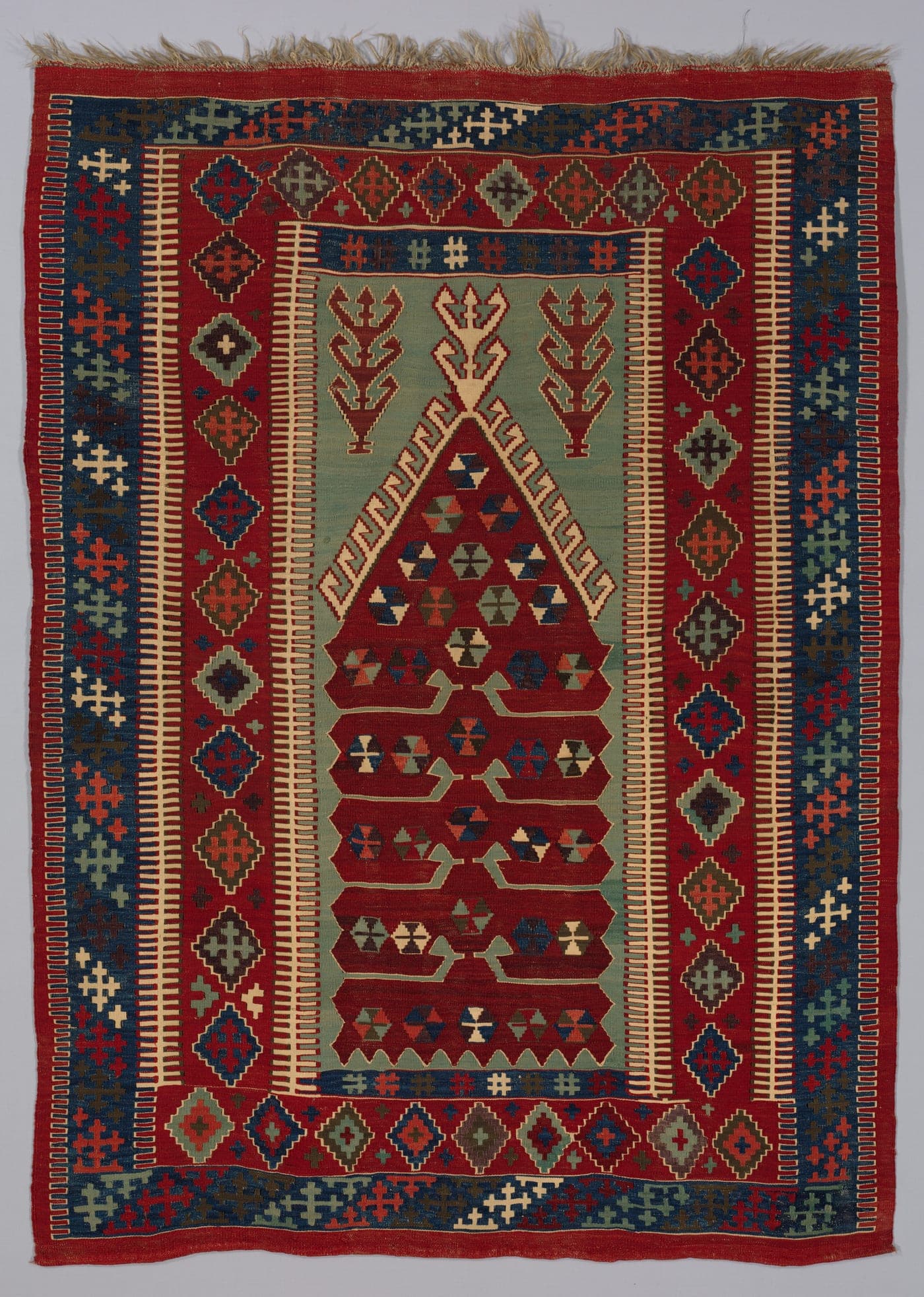
Look at where the colours meet. There is barely a straight vertical edge anywhere in this rug — every boundary steps or runs diagonally, because a long vertical join would leave a slit long enough to weaken the fabric. The design language is the structure, showing.
tapestry weave: wool and cotton
Cleveland Museum of Art, 1961.388 · Florence and Charles Abel Oriental Rug Collection · CC0
Soumak
The weft is wrapped around pairs of warps rather than passed straight through, producing a surface that reads as fine braiding or plaiting running across the rug.
The result is heavier, denser and stronger than slit-weave, with no slits at all, and it allows curved and complex motifs that slit-weave cannot. It is not fully reversible — the back carries loose weft ends.
Caucasian soumak, particularly from Shirvan and the Kuba region, is the classic body of work here, and it is among the most collectable flatweaving there is.
Cicim (jajim)
A plain woven ground with extra decorative weft laid over the top in small, often floral motifs — the effect is close to embroidery worked during weaving rather than after.
That distinction matters: suzani is embroidery added to a ground cloth, not an extra-weft flatweave technique.
Lighter than soumak, more delicate, and the added weft is exposed on the surface, so cicim wears faster underfoot than either of the above. Frequently better used on a wall or over furniture than on a floor.
Jijim
Narrow strips woven separately on a portable loom and then sewn together into a larger piece. The seams are visible and are a feature of the tradition, not a repair.
This is nomadic weaving in the most literal sense: the loom had to be small enough to carry, so the rug was made in bands.
The regional traditions
Turkish — Anatolian kilims are the largest and most varied body of work. Konya, Karapinar, Aydın, Malatya, each with recognisable palettes and motif vocabularies. Bold, large-scale, and the source of most kilims in Western markets.
Persian — Senneh kilims are the finest, woven so tightly they resemble a textile more than a rug. Qashqai and Bakhtiari kilims are the tribal end: heavier, brighter, more improvisational.
Caucasian — high-contrast geometry, superb soumak, and the palette that influenced modern design more than any other flatweaving.
Afghan and Central Asian — Maimana kilims are the volume product of the contemporary market: durable, dark-palette, and consistently good value.
Moroccan — Hanbel, in bold bands with areas of raised weft. A distinct tradition rather than a variant of the above.
Indian — the dhurrie, historically cotton rather than wool, lighter and flatter, and the source of most inexpensive flatweaves sold today.
Navajo — an entirely independent North American tradition using a tapestry weave, and not a kilim in any historical sense despite the visual overlap.
Telling them apart by hand
Four checks, none needing expertise.
Hold it to a light. Slits mean slit-weave. No slits on a flatweave with complex motifs means soumak.
Turn it over. Identical on both sides means true kilim. A back carrying loose threads means soumak or cicim.
Feel the weight. Soumak is noticeably heavier and stiffer than slit-weave of the same size.
Look for seams. Long straight joins running the length of the rug mean jijim, and they are original.
What a slit-weave kilim gives up, and what it buys
No pile means nothing traps a spill deep in the rug, it dries in hours, it is light enough to lift and take outside, and it costs a fraction of a knotted rug of comparable quality. It also means no cushioning and no sound absorption. That trade makes kilims the right answer for dining rooms, halls and layering, and the wrong one where you want comfort underfoot.
Buying
Check for old repairs at the slits, which is where slit-weave fails first. Small restitching is normal maintenance; long open runs need work — rug repair.
Expect a kilim to lie less flat than a pile rug. They ripple, particularly when new, and they settle. A pad makes a substantial difference here — more than it does under a heavy knotted rug.
Natural dye behaves as it does everywhere. Bend the weave and look at the base of the thread against the surface — rug colors.
Prices are low relative to quality, because flatweaving is faster than knotting. A genuine antique tribal kilim can cost less than a new commercial pile rug, which makes this one of the better-value corners of the whole market — rug prices.
For the tradition overall see kilim rugs, and for the construction in general, flatweave rugs.
Common questions
What is the difference between a kilim and a soumak?
Kilim is slit-woven — the weft passes back and forth within its own colour area, which leaves small vertical slits where two colours meet. Soumak has the weft wrapped around the warps rather than passed straight through, giving a braided surface, a heavier fabric, and no slits at all.
Are kilims reversible?
True slit-weave kilims are, and near-identical on both sides — which is one of the quickest authenticity checks. Soumak, cicim and jijim are not fully reversible, because the wrapping or the added decorative weft sits on the front face and leaves loose threads on the back.
Is a kilim a rug or a tapestry?
Both, technically — it is a weft-faced tapestry weave, and the same structure is used for wall hangings, floor rugs, bags, saddlebags and grain sacks. What makes it a rug is scale and use, not a difference in construction.