
The rug trade has a vocabulary that runs to a few hundred words, most of which describe something real. A handful exist mainly to make a rug sound like more than it is, and those are flagged here rather than omitted.
Terms are grouped by what they describe. For how the words fit together, see types of rugs and how rugs are made.
Construction
Warp — the vertical threads held under tension on the loom, running the length of the rug. Usually cotton in city weaving, wool in tribal. The warps continue past the pile at both ends and become the fringe.
Weft — the horizontal threads passed between the warps after each row of knots, locking the row in place. Two wefts per row is typical; the count is a regional tell.
Foundation — warp and weft together: the structural fabric of the rug, everything that is not pile.
Pile — the surface you walk on, made of the cut ends of the knots. Measured in height; see types of rugs for what each height suits.
Knot — a length of yarn wrapped around adjacent warps and cut, forming two tufts of pile. The unit of hand-knotted weaving.
Symmetric knot (Turkish, Ghiordes) — wrapped around two warps symmetrically. Robust, slightly less able to render curves. Predominant in Turkish, Caucasian and much tribal weaving.
Asymmetric knot (Persian, Senneh) — wrapped around two warps with the yarn passing under one. Allows finer detail and curvilinear design. Predominant in Persian, Indian and Chinese weaving.
Tibetan knot — a continuous loop wrapped around a gauge rod, then cut. A third system, faster than knotting, used across Tibetan and Nepalese production.
Spanish knot — a fourth, largely extinct: the yarn wraps a single warp rather than a pair, on alternate warps in alternate rows. Used in medieval Spanish weaving and almost nowhere else.
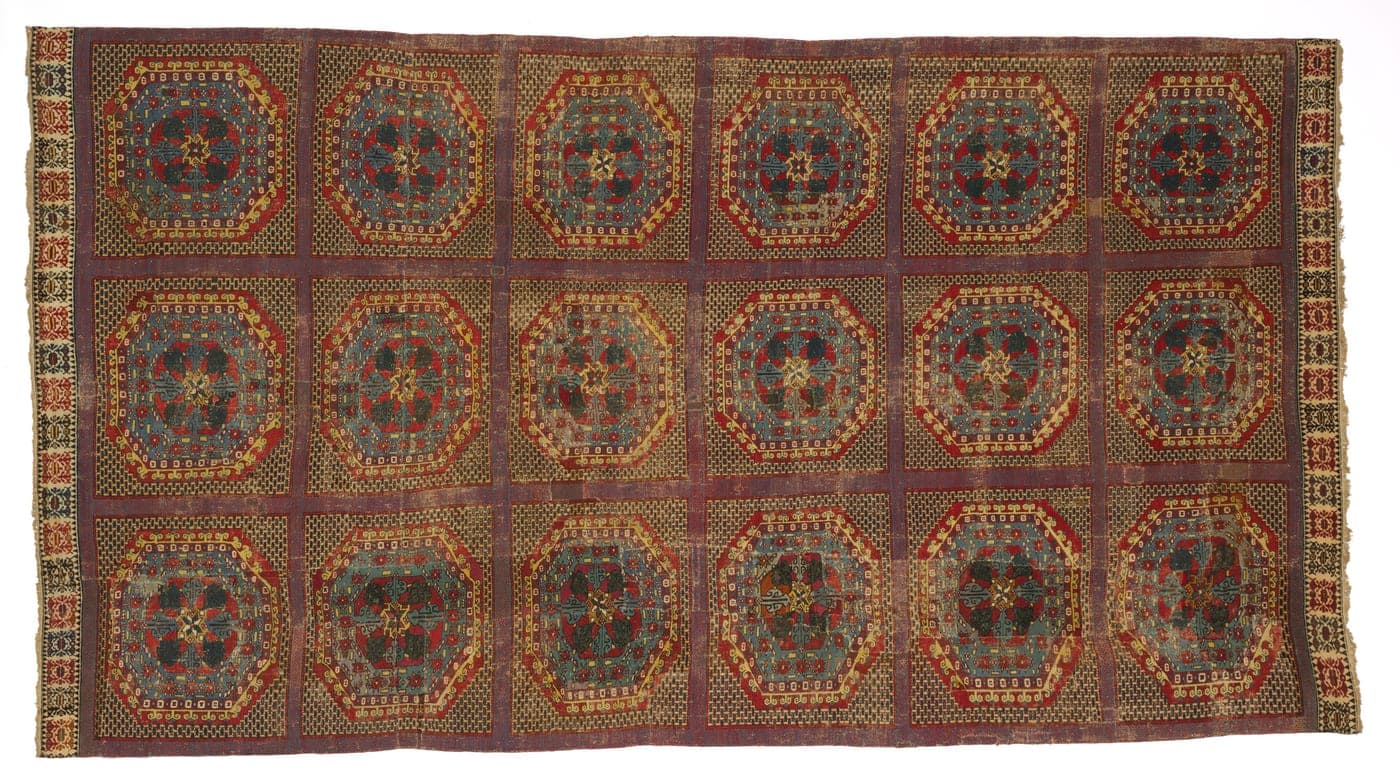
Mudéjar weaving from Alcaraz, using the Spanish single-warp knot. It is worth knowing this exists: the symmetric-versus-asymmetric distinction that identification guides lean on describes the two systems that survived, not the only two that were ever used.
wool, knotted pile: Spanish knot
Cleveland Museum of Art, 1952.511 · Purchase from the J. H. Wade Fund · CC0
KPSI — knots per square inch, counted on the back. Roughly: 30–80 coarse tribal, 100–200 good city weaving, 300+ very fine, 500+ exceptional and usually silk. Detail rather than quality — see hand-knotted rug quality.
Selvedge (also selvage) — the finished side edge, where the outer warps are bound or overcast. A wear point, and a useful indicator of care and restoration.
Fringe — on a hand-knotted rug, the warp threads themselves emerging from the foundation. On a machine-made or tufted rug, a separate strip sewn on. That distinction is one of the fastest authenticity checks available — cleaning rug fringes.
Kilim end — a band of flatweave at the top and bottom of a pile rug, before the fringe, which stops the last knot rows from unravelling.
Scrim — the fabric backing glued over the underside of a hand-tufted rug. Its presence means latex adhesive, a fifteen-year ceiling, and no possibility of reweaving.
Weaving and technique
Flatweave — woven with no pile at all, the pattern formed by the wefts themselves. Kilim, soumak, dhurrie. See flatweave rugs.
Kilim — the best-known flatweave technique, slit-woven, so vertical colour boundaries leave small gaps. Also used loosely to mean any flatwoven rug.
Soumak — a flatweave with the weft wrapped rather than passed straight through, giving a braided surface and a heavier, denser fabric.
Dhurrie — the Indian flatweave tradition, historically cotton.
Loom — the frame holding the warps under tension. Horizontal ground looms are portable and used by nomadic weavers, which is why nomadic rugs are narrow; vertical looms are fixed in workshops and allow any size.
Cartoon — the scaled drawing a workshop weaver follows, knot by knot. Its absence is what gives village and nomadic weaving its variation.
Loom-finished / loomed — vague terms with no fixed meaning. Ask what construction is actually meant.
Design
Field — the main area of the rug inside the borders.
Border — the framing bands. A main border with narrower guard borders either side is the standard arrangement.
Medallion — the central design element, usually round or lozenge-shaped, anchoring a classical traditional layout.
Spandrels — the corner pieces of a medallion design, echoing a quarter of the medallion.
Boteh — the teardrop-with-a-bent-tip motif that became the paisley pattern in the West after Kashmir shawls reached Europe. See rug motifs.
Gul — a repeating geometric medallion in Turkmen weaving, historically identifying the tribe.
Herati — a repeating field pattern of a rosette inside a diamond flanked by curved leaves. The most widespread field design in Persian weaving.
All-over — a field pattern that repeats without a central medallion. The most practical choice for a room in use, because it disguises soil and furniture marks.
Mihrab — the arch form in a prayer rug, oriented toward Mecca in use.
Open field — a plain or near-plain field. Beautiful, and it shows every mark.
More in rug patterns and rug symbolism.
Colour and dye
Abrash — horizontal banding where the weaver changed dye batch. A hallmark of small-batch natural dyeing and of hand weaving; desirable.
Madder — the root dye behind almost all traditional red. Ages towards brick.
Indigo — the vat dye behind essentially all traditional blue. Depth comes from repeated dipping.
Cochineal / lac — insect-derived reds, bluer and costlier than madder.
Aniline — the first synthetic dyes, from the 1870s. Often fugitive; fade towards grey or brown. A dating indicator.
Chrome dye — modern synthetic dye, genuinely lightfast and stable. Flatter than natural dye and without batch variation.
Corrosion — the erosion of pile in iron-mordanted black or dark brown areas, where the mordant has chemically attacked the wool over decades. The dark areas sit lower than the rest, and you can feel it. Hard to fake.
Colour run / bleeding — dye migrating when wet. Test with a damp white cloth before any cleaning — rug colors.
Chemical wash — a post-weaving treatment to soften colour or add sheen. Common and not inherently dishonest; heavy washing weakens wool.
Overdyed — an existing rug stripped and redyed a single saturated colour. Irreversible, and it substantially reduces the value of anything that had value — vintage rugs.
Condition and restoration
Reweaving — rebuilding lost pile and foundation knot by knot. The proper repair for a hand-knotted rug, and the reason construction matters — rug repair.
Reduced / cut down — a rug made smaller, usually to remove damage or to fit a room. Detectable at the borders, where the pattern no longer resolves. It materially reduces value and is not always disclosed.
Painting / tipping — colouring worn pile with ink or dye to disguise wear. It washes out. A red flag — antique rug red flags.
Moth damage — grazed or bald patches, usually in undisturbed areas under furniture, with fine webbing and grit. See moth damage.
Dry rot — foundation weakened by prolonged damp. The rug cracks rather than folds. Often terminal.
Sun fading — permanent, and it is unevenness rather than fading that ruins a rug. Rotate twice a year.
Trade terms to treat carefully
Words that describe the sale, not the rug
Investment grade — meaningless; no such grading system exists. Genuine handmade — true of hand-tufted rugs as well, so it distinguishes nothing. Art silk / bamboo silk / banana silk — all viscose. Palace size — a size, not a provenance. Semi-antique — undefined; ask for a decade. Museum quality — no museum issues this. Certificate of authenticity written by the seller — a statement of the seller's own claim.
Oriental — an origin (broadly Asia), not a style, though it is used as both.
Persian — woven in Iran, in a Persian design tradition. It describes origin and design language, not quality — Persian rugs.
Antique — a hundred years or more, applied honestly. Vintage — roughly twenty to a hundred, and the loosest term in the trade.
Area rug — any loose rug covering part of a floor. A size and placement category, not a type — area rugs.
Where to take this next
The vocabulary is most useful applied. Types of rugs sorts the terms into the four axes every rug is described by; rug authentication turns them into checks you can run on a rug in front of you; and the rug buying guide puts them in the order you will need them in a shop.
Common questions
What does KPSI mean?
Knots per square inch — the density of a hand-knotted rug, counted on the back. It correlates with fineness of detail and with labour, and it is not a quality score on its own: a coarse tribal rug at 40 KPSI can be a far better object than a 300 KPSI commercial piece in poor wool.
What is abrash in a rug?
Horizontal banding where the weaver moved to a new batch of dyed yarn. It is a natural consequence of small-batch dyeing, characteristic of hand weaving with natural dye, and now regarded as desirable rather than as a fault.
What is the selvedge of a rug?
The finished side edge, where the outermost warps are bound — usually overcast or wrapped in wool. It is a wear point and a repair tell: a rug with intact original selvedges has been looked after, and a rebound edge is honest restoration rather than damage.